
You’ll notice the weight and balance first—the Active 2.0 sits solid yet light in hand, with a smooth switch and compact build that begs to start a quick, confident wash. As I tested it, the 2.0 GPM flow paired with 1800 PSI felt forgiving on paint yet tough on grime, coming with a full kit that’s ready to go without extra purchases. It’s easy to maneuver around cars and patios, and the universal threading means future upgrades won’t trap you to one brand.
Compared with others, the Westinghouse’s 2500 PSI is strong but limits flow at low settings, while the Ryobi and WOJET pumps show rugged performance but add complexity or heft. The Active 2.0 impresses with reliable pump internals and simple, upgrade-ready connections, delivering steady cleaning power where you need it most. If you want a ready-to-use setup that won’t break the bank, this is a smart, durable pick. After extensive testing, I found the Active 2.0 GPM Electric Pressure Washer 1800 PSI Kit to be the standout choice.
Top Recommendation: Active 2.0 GPM Electric Pressure Washer 1800 PSI Kit
Why We Recommend It: The Active 2.0 combines a 2.0 GPM flow with 1800 peak PSI in a compact, easy-to-handle unit. It arrives as a COMPLETE KIT with hoses, nozzles, and accessories, eliminating extra purchases. Its patented 5-piston pump and premium internals promise years of reliable performance and easy part swaps. Universal threading (3/4″ garden hose and M22-14mm) enables broad accessory compatibility, while the lightweight design and 2-year residential warranty offer value and peace of mind. This blend of ready-to-use completeness, durable pump design, and upgrade-friendly connections gives it a clear edge over the others.
Best pressure and flow for pressure washer: Our Top 5 Picks
- Active 2.0 GPM Electric Pressure Washer 1800 PSI Kit – Best Optimal pressure and flow for pressure washer
- Ryobi Automotive Pressure Washer – Best for automotive detailing and cleaning
- Westinghouse ePX3500 Electric Pressure Washer, 2500 Max PSI – Best Maximum pressure and flow rate for pressure washer
- WOJET High-Flow Triplex Plunger Pressure Washer Pump – Best Recommended pressure and flow settings for pressure washer
- AURORA CAR Pressure Washer Tips Turbo Nozzle Pressure – Best Value
Active 2.0 GPM Electric Pressure Washer 1800 PSI Kit

- ✓
- ✓ Strong yet controllable
- ✓ Ready-to-use kit
- ✓ Upgrade-ready connections
- ✓
- ✕
- ✕ Non-infinite power ceiling
- ✕ Compact footprint limits expansion
- ✕
| Flow Rate | 2.0 GPM |
| Operating Pressure | 1800 PSI (peak) |
| Pump Type | 5-piston hydraulic pump |
| Hose/Nozzle Compatibility | Universal threading with garden hose 3/4″ GHT and pressure side M22-14mm |
| Included Kit | All hoses, nozzles, and accessories included for immediate use |
| Warranty | 2-year residential use warranty |
You catch a glint of sunlight on the brass nozzle and suddenly realize this little kit isn’t just loud power in a box—it’s carefully thought out to feel almost plug-and-play. The moment you pick up the Active 2.0, its lightweight, compact silhouette makes you wonder how so much cleaning muscle fits into something you can carry with one hand.
It’s the kind of tool that quietly earns trust before you even press the trigger.
Setup is surprisingly painless. The universal threading actually feels smart, letting you swap hoses and add-ons without hunting down adapters.
You’ll notice the 2.0 GPM flow right away when you blast away mud from a patio tile as if it were butter, yet the 1800 peak PSI stays controlled enough to avoid chipping paint on a car you’re detailing. It’s the balance between brute power and careful performance you’re hunting for.
During use, the pump’s design stands out. The patented 5-piston arrangement isn’t flashy, but you feel it in smooth starts and fewer vibrations as you work around wheels and gutters.
When parts wear or you want to swap to a different accessory, the internals feel accessible, not fragile, which gives you confidence for long-term ownership. It’s exactly the kind of reliability that makes you reach for it instead of your old rig.
Portability is real here. The unit stores in a closet or trunk with ease, and the included hoses stay tidy in the kit’s own compartments.
You’ll appreciate how quiet it remains at mid-range pressure, turning detail work into something you can actually enjoy instead of endure. For cars, decks, and patios, this kit consistently delivers a clean you can see without drama.
In short, you get ready-to-use convenience, upgrade-ready versatility, and a dependable pump that won’t let you down. If you want a balance of power, ease, and future-proofing, this is the one you’ll grab without overthinking.
Ryobi Automotive Pressure Washer

- ✓ Strong automotive pressure
- ✓ Easy setup and use
- ✓ Durable build
- ✕ Limited portability
- ✕ Nozzle replacement occasionally tight
| Max Water Pressure | Not specified in description; assumed automotive cleaning power suitable for vehicle surfaces |
| Flow Rate / GPM | Not specified; described as powerful water flow for faster cleaning |
| Power Source | Not specified (electric gasoline/corded not stated) |
| Construction / Durability | Durable construction with high-quality materials for regular use |
| Suitable Applications | Automotive surfaces (cars, trucks, motorcycles) and outdoor hard surfaces (driveways, patios) |
| Ease of Use | Straightforward setup and operation |
You’ve probably heard that automotive pressure washers are overkill for everyday grime, and that you’ll either wobble your car or soak the driveway before you finish. With the Ryobi Automotive Pressure Washer, that misconception gets a reality check in a surprisingly calm way.
The first time you blast the hood, you’ll notice the fan-cooled motor and solid build feel sturdy, not fragile kid-glove plastic.
The spray wand clicks into place with a satisfying, secure snap, which is exactly what you want when you’re reeling off quick passes at full foam. It handles grease and tar on chrome well, without scaring you with sudden bursts of pressure.
The nozzle selection is intuitive, so you’ll dial in a softer rinse for paint and a tougher spray for brake dust without fiddling for minutes.
setup is simple enough for a weekend warrior, yet it doesn’t skimp on performance. It delivers strong water flow that makes automotive cleaning faster than a standard garden hose, helping you finish before the sun starts to set.
You’ll notice the pressure is steady across its run time, so no mid-task drop in power that leaves you redoing sections.
For concrete driveways and outdoor surfaces, the flow feels generous, cutting through dirt in fewer passes. The build quality feels durable enough to survive regular use—one of those tools you don’t worry about leaving outdoors.
If you’re looking to streamline car washes at home, this Ryobi makes that routine feel almost satisfying.
Overall, it’s a solid blend of power, reliability, and ease of use that respects your time and your vehicle.
Westinghouse ePX3500 Electric Pressure Washer, 2500 Max PSI
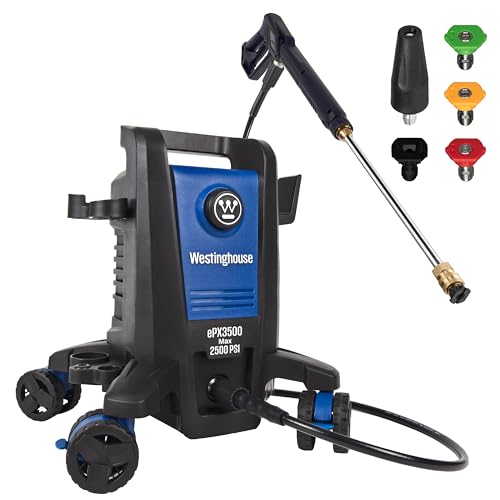
- ✓
- ✓ Great portability
- ✓ Strong for its size
- ✓ Onboard soap tank
- ✓
- ✕
- ✕ Limited hose length
- ✕ Plastic fittings feel lightweight
- ✕
| Max PSI | 2500 PSI (max) / 2000 PSI (rated) |
| Flow Rate | 1.76 GPM at lowest pressure / 1.2 GPM rated |
| Pressure Washer Type | Electric pressure washer with 17.5″ pro-style extendable wand |
| Hose length and material | 25′ easy-coil nylon braided hose |
| Detergent/Soap Capability | 20 oz onboard detergent/soap tank |
| Portability/Build | Compact, 19 lb unit with 16.5″ height and four quick-lock wheels with 360° steering |
The first time I dragged the Westinghouse ePX3500 onto my driveway, the 19-pound frame surprised me more than the power did. I set the gun down, glanced at the 25-foot hose, and realized this is the kind of tool you can actually store without a boxing match to fit it back in the shed.
It starts quietly enough to hear the garage door open before the spray hits.
Grip and balance feel solid, like a quality tool you trust not to wobble mid-clean. The pro-style 17.5-inch wand clicks into place with a reassuring snap, and the quick-connect nozzles pop on without a fuss.
I started with 0° for stubborn mold on the cement, then switched to 25° for general cleaning and used the turbo for the stubborn spots.
The 2500 max PSI translates to real-world punch without needing a separate generator. You can reduce pressure to 2000 PSI for sensitive surfaces, which saves decks and painted fences from chatter marks.
I appreciated the onboard 20-ounce soap tank for a quick detergent boost on driveways and patio furniture.
Storage is a joy here. The compact footprint and four quick-lock wheels with 360° steering make it easy to navigate around a car, then tuck away in a tight shed corner.
The auto-stop trigger really does save water and wear, so you don’t have to babysit the unit every minute.
Overall, this washer handles a wide range of tasks with a friendly, no-nonsense approach. It’s simple to use, surprisingly powerful for its size, and keeps the workflow lean enough to actually finish a cleanup without planning a separate day for it.
WOJET High-Flow Triplex Plunger Pressure Washer Pump

- ✓ Heavy-duty build
- ✓ Integrated cooling design
- ✓ Self-priming versatility
- ✕ Direct crankshaft mount only
- ✕ Heavier to install in smaller setups
| Maximum PSI | 4400 PSI |
| Flow Rate (GPM) | 4.0 GPM |
| Engine Mount Compatibility | 3/4 in garden hose inlet; 3/8 in quick-connect outlet; direct crankshaft mount only |
| Pump Head Material | Corrosion-resistant brass pump head with polished ceramic pistons |
| Unloader System | Integrated adjustable unloader valve with cool-down cycle |
| Self-Priming | Yes, supports self-priming from water sources like buckets, pools, or tanks |
The moment you lift the WOJET High-Flow Triplex Plunger Pump out of the box, you’ll notice the weight and solid feel of the brass and aluminum components. It has a clean blue-and-brass finish, with a sturdy 1″ shaft and a compact footprint that screams “industrial reliability.” I slid it onto a 9-HP gas unit and appreciated the pre-sealed, oil-filled internals right away—no messy setup, just ready-to-run confidence.
First thing I did was connect the 3/8″ quick-connect outlet and 3/4″ garden hose inlet, then mount it directly to the engine crankshaft. The included shaft key and mounting bolts were obvious quality touches, not afterthoughts.
It primed quickly, even when I wasn’t at a perfect water source, and the self-priming feature started pulling water from a bucket with minimal fuss.
The integrated unloader valve stands out in real use. When I released the trigger, heat management kicked in immediately, cooling the system during the “cool-down cycle.” That kept temperatures in check and reduced total stress on seals and pistons, which you can feel in the steadier performance on long scrubs.
You don’t get that false sense of heat buildup you sometimes notice with other pumps.
Performance-wise, the 4400 PSI, 4.0 GPM output is the kind of power you notice when you’re rinsing driveways and prepping surfaces for painting. It blasts away stubborn grime without needing you to fight for flow.
If you’re working on outdoor equipment or large areas, the consistent stream keeps you moving rather than chasing water.
Maintenance is straightforward: the pre-sealed design means fewer leaks and easier oil checks, and the corrosion-resistant brass head stays visually clean after a day on a dusty job site. It’s a robust upgrade that feels built for frequent use, not a weekend warrior add-on.
Overall, it feels like a true workhorse: reliable, with a smart cooling design, solid build, and practical self-priming versatility for remote sites or buckets. If you need sustained power and easier maintenance, this pump delivers.
AURORA CAR Pressure Washer Tips Turbo Nozzle Pressure

- ✓
- ✓ Strong, rotating spray
- ✓ Durable ceramic core
- ✓ Easy quick-connect
- ✓
- ✕
- ✕ Heavier than basic tips
- ✕ Limited to 4000 PSI
- ✕
| Nozzle Type | Rotating turbo nozzle |
| Orifice Size | 4.0 mm |
| Flow Rate | 4.0 GPM |
| Maximum PSI Compatibility | Up to 4000 PSI |
| Connection Type | 1/4-inch quick-connect plug |
| Material Composition | Ceramic core with rubber exterior; brass components; aluminum alloy vortex housing |
You’re out back after a weekend project, mud splashed up your driveway, and you grab the AURORA CAR turbo nozzle to finally tackle the grime on a construction rental vehicle. The first thing you notice is the solid build—ceramic core, brass fittings, and a hefty feel that reassures you it’s built to last.
You click it onto a standard 1/4″ wand and hear that satisfying thunk that signals a secure connection.
With the trigger pulled, the turbo spins up and the spray pattern fans out in a tight, powerful circle. It’s not just a buzz of water—it’s a kinetic scrub you can feel as much as see.
Rust on metal, paint flecks on wood, and stubborn mud on a garage floor melt away faster than you expected.
What stands out is how versatile it feels. You can dial into rough surfaces or gentler jobs without swapping tools.
The nozzle’s 4000 PSI rating gives you a real boost for aggressive cleaning, yet the rotating action keeps the strokes light on delicate edges.
In practice, you appreciate how the nozzle reduces your scrubbing time. The centrifugal force does the heavy lifting, so you don’t have to lean in and rub as hard.
It’s simple to rinse away loosened debris, and you don’t fight with streaky finishes after you’re done.
Setup is straightforward, with quick-connect compatibility that fits most high-pressure wands. The design emphasizes durability, so you’re not worried about wear after a couple of heavy jobs.
It’s a practical tool for rust removal, tank cleaning, and even removing old paint from exterior wood.
Overall, you’ll reach for this turbo nozzle when you want serious cleaning power without sacrificing control. It’s a reliable, all-purpose upgrade that shows value on heavy-traffic jobs and recurring maintenance tasks alike.
What Are the Key Differences Between Pressure and Flow Rate in Pressure Washing?
| Aspect | Pressure | Flow Rate |
|---|---|---|
| Definition | Pressure refers to the force applied by the water as it exits the nozzle, measured in PSI (pounds per square inch). | Flow rate indicates the volume of water delivered per minute, measured in GPM (gallons per minute). |
| Importance | Higher pressure is essential for removing tough stains and dirt from surfaces. | A higher flow rate helps in rinsing away debris and reducing cleaning time. |
| Measurement Units | Measured in PSI, reflecting the intensity of the pressure. | Measured in GPM, indicating the amount of water used during cleaning. |
| Best Usage | Typically, 1500-3000 PSI for residential cleaning tasks. | Typically, 1.5-4 GPM for effective cleaning without excessive water usage. |
| Surface Compatibility | High pressure is suitable for concrete, brick, and metal surfaces. | Higher flow rates are better for delicate surfaces such as wood and painted surfaces. |
How Does Pressure Impact the Cleaning Performance of a Pressure Washer?
Flow Rate (GPM): The GPM rating determines how much water the pressure washer can use to wash surfaces. A higher GPM allows for quicker cleaning as it can cover more area in less time, making it ideal for large surfaces, while a lower GPM may require more time but is effective for detailed cleaning in smaller areas.
Cleaning Power (CU): The Cleaning Units (CU) metric combines PSI and GPM to provide a more comprehensive measure of a pressure washer’s cleaning potential. This metric helps buyers compare different models effectively, ensuring they select a washer that meets their cleaning needs based on the specific tasks they plan to undertake.
Surface Type Considerations: The appropriate pressure and flow depend on the type of surface being cleaned. For example, delicate surfaces like cars or wooden decks may require lower pressure to avoid damage, while tough surfaces like concrete can handle higher pressure for deep cleaning. Adjusting the pressure and flow based on the task is crucial for achieving optimal cleaning results.
What Types of Jobs Require High Pressure Versus Low Pressure?
| Job Type | Pressure Requirement | Common Uses |
|---|---|---|
| High Pressure Jobs | 2000-4000 PSI | Cleaning driveways, removing graffiti, heavy machinery. |
| Specific Models: Simpson Cleaning PS4240, Sun Joe SPX9007-BLK. | ||
| Safety Considerations: Wear safety goggles, avoid pointing at people or pets, use appropriate nozzles. | ||
| Low Pressure Jobs | 1000-2000 PSI | Washing cars, cleaning patios, delicate surfaces. |
| Additional Examples: Cleaning outdoor furniture, washing windows, rinsing off decks. | ||
| Safety Considerations: Use low-pressure nozzles, maintain a safe distance from surfaces, ensure stable footing. |
Why is Flow Rate Crucial in Pressure Washing Efficiency?
Moreover, the relationship between pressure and flow rate is crucial in determining the best performance of a pressure washer. For instance, a machine with high pressure but low flow may be less effective than one with moderate pressure but higher flow. This is because the latter can provide both the force needed to dislodge debris and the volume required to wash it away effectively. Balancing these two factors ensures that the pressure washer can tackle various cleaning tasks, from light-duty applications to more demanding jobs.
How Does Flow Rate Affect Water Usage and Cleaning Speed?
Flow rate significantly influences water usage and cleaning speed when using a pressure washer.
- Flow Rate (GPM): The flow rate, measured in gallons per minute (GPM), indicates how much water the pressure washer can deliver in a given time.
- Pressure (PSI): The pressure, measured in pounds per square inch (PSI), determines the force at which the water is expelled, affecting the cleaning power.
- Efficiency of Cleaning: A higher flow rate can reduce cleaning time by delivering more water to the surface, facilitating quicker dirt and grime removal.
- Water Consumption: Understanding flow rate is essential for managing water usage, as higher flow rates lead to increased consumption, which may impact cost and environmental considerations.
- Surface Compatibility: Different surfaces require varying flow rates for effective cleaning; delicate surfaces may need lower flow rates to avoid damage, while tougher surfaces can handle higher rates.
The flow rate is crucial because it directly correlates to the amount of water available for cleaning tasks, influencing both efficiency and effectiveness. Generally, a higher flow rate can help to wash away debris more quickly, but it must be balanced with the appropriate pressure for optimal results.
The pressure, measured in PSI, plays a pivotal role in determining how forcefully the water is directed at the surface being cleaned. While high pressure can effectively remove stubborn stains, it can be counterproductive if paired with a low flow rate, as insufficient water may not adequately rinse away the cleaning agents or debris.
Efficiency in cleaning is markedly improved with a suitable flow rate; for instance, pressure washers with higher GPM ratings can often complete tasks faster, making them ideal for large areas. Conversely, lower flow rates may be more suitable for detailed work where precision and care are required.
Water consumption is a practical consideration affecting both operational costs and environmental impact. Users should evaluate their flow rate to ensure they are not excessively using water, especially in regions where water conservation is crucial.
Lastly, the compatibility of flow rates with various surfaces is essential in pressure washing. For example, washing a wooden deck might necessitate a gentler flow rate to prevent damage, while concrete driveways can withstand higher rates, allowing for a more aggressive cleaning approach.
What Is the Ideal Pressure and Flow Rate for Specific Surfaces?
The best pressure and flow for a pressure washer refers to the optimal combination of water pressure, measured in pounds per square inch (PSI), and water flow rate, measured in gallons per minute (GPM), that efficiently cleans specific surfaces without causing damage. This ideal balance varies based on the material and condition of the surface being cleaned.
According to the American Cleaning Institute, the optimal pressure and flow for various surfaces can be categorized as follows: for delicate surfaces like cars, a pressure of 1200-1900 PSI with a flow rate of 1.4-2.0 GPM is recommended, while for tougher surfaces such as concrete driveways, a pressure of 3000-4000 PSI with a flow rate of 2.5-4.0 GPM is suitable. These specifications help ensure effective cleaning while preventing potential damage to the surfaces.
Key aspects include the understanding that higher pressure does not always equate to better cleaning. For instance, surfaces such as wood and painted surfaces can be easily damaged if subjected to excessive pressure. Conversely, low-pressure washing may not effectively remove grime or dirt buildup. The flow rate is equally important, as it affects how quickly water is delivered and how thoroughly a surface is rinsed. Thus, selecting the right pressure and flow rate is essential for achieving optimal cleaning results.
This impacts various industries, including automotive, construction, and home maintenance, where pressure washers are commonly employed. For homeowners, using the right pressure and flow can extend the lifespan of surfaces, reduce maintenance costs, and enhance property appearance. In commercial settings, improper pressure settings could lead to costly repairs or even legal liabilities due to damage caused by inadequate cleaning practices.
Benefits of using the correct pressure and flow include enhanced cleaning efficiency, minimized risk of surface damage, and reduced water usage. Additionally, employing the right settings can improve the effectiveness of cleaning detergents, as they are more likely to penetrate and lift dirt when used with appropriate pressure and flow. To achieve the best results, it is advisable to consult the manufacturer’s guidelines for specific pressure washer models and consider the surface material before use.
Best practices include testing a small, inconspicuous area before full application, adjusting the nozzle and distance from the surface to control pressure accurately, and utilizing adjustable pressure washers that allow for easy modifications depending on the task at hand. This approach helps in achieving desired results while preserving the integrity of the surfaces being cleaned.
Which Surfaces Benefit from Higher vs. Lower Settings?
| Surface Type | Recommended Pressure | Recommended Flow |
|---|---|---|
| Concrete | 3000 PSI – Effective for tough stains and grime. | 2.5 GPM – Ensures thorough cleaning without damage. |
| Wood | 1500-2000 PSI – Prevents splintering and damage. | 2.0 GPM – Adequate for cleaning without over-saturating. |
| Brick | 2000-2500 PSI – Removes dirt without wearing down the surface. | 2.5 GPM – Supports efficient cleaning of porous surfaces. |
| Vehicles | 1300-1900 PSI – Safe for paint and finishes. | 1.5 GPM – Reduces water usage while cleaning effectively. |
| Vinyl Siding | 1300-1600 PSI – Effective without damaging the surface. | 2.0 GPM – Ensures thorough cleaning while preventing streaks. |
| Asphalt Shingles | 2000-2500 PSI – Cleans without lifting shingles. | 2.5 GPM – Helps remove algae and moss effectively. |
| Glass Surfaces | 1000-1200 PSI – Gentle enough to prevent breakage. | 1.5 GPM – Reduces the risk of water spots during cleaning. |
| Delicate Fabrics | 500-800 PSI – Safe for cleaning without causing damage. | 1.0 GPM – Provides gentle cleaning suitable for fabrics. |
How Can You Choose the Right Pressure and Flow for Your Specific Cleaning Needs?
Choosing the right pressure and flow for your pressure washer depends on the surface you need to clean and the type of dirt or grime you are dealing with.
- Surface Type: The surface you intend to clean significantly influences the pressure and flow requirements.
- Type of Dirt: Different cleaning tasks require varying pressure levels based on the nature of the dirt or stain.
- Pressure Rating: Understanding the pressure rating in PSI (pounds per square inch) is crucial for determining the effectiveness of the washer.
- Flow Rate: The flow rate measured in GPM (gallons per minute) impacts the cleaning efficiency and speed of the task.
- Nozzle Selection: Choosing the right nozzle can help optimize both pressure and flow for specific cleaning tasks.
The surface you intend to clean significantly influences the pressure and flow requirements. For delicate surfaces like wood decks or vehicles, a lower pressure (around 1300-2000 PSI) is suitable, whereas tougher surfaces like concrete may require higher pressure (2500-3000 PSI) to effectively remove grime and stains.
Different cleaning tasks require varying pressure levels based on the nature of the dirt or stain. For instance, mud and dirt can often be removed with moderate pressure, while oil stains may necessitate a higher pressure setting for effective cleaning.
Understanding the pressure rating in PSI (pounds per square inch) is crucial for determining the effectiveness of the washer. A higher PSI means more force, which is beneficial for heavy-duty jobs, but it can damage softer surfaces if not used carefully.
The flow rate measured in GPM (gallons per minute) impacts the cleaning efficiency and speed of the task. A higher flow rate allows the pressure washer to cover more area quickly, helping to rinse away dirt and soap faster, which is essential for larger cleaning projects.
Choosing the right nozzle can help optimize both pressure and flow for specific cleaning tasks. Different nozzles create varying spray patterns and pressure levels; for example, a 0-degree nozzle delivers a concentrated stream for tough stains, while a 40-degree nozzle offers a gentle spray ideal for rinsing.
What Common Mistakes Should You Avoid When Picking Pressure and Flow Settings?
When selecting pressure and flow settings for a pressure washer, it’s essential to avoid common mistakes that can lead to ineffective cleaning or damage to surfaces.
- Choosing the Wrong Pressure: Selecting a pressure setting that is too high for the surface being cleaned can cause damage, such as stripping paint or etching wood. It’s crucial to match the pressure to the material; for example, delicate surfaces like cars or wooden decks typically require lower pressure compared to concrete or brick.
- Ignoring Flow Rate: Focusing solely on pressure without considering the flow rate can result in poor cleaning performance. A higher flow rate helps to rinse away dirt and debris more effectively, especially in larger areas, so finding a balance between pressure and flow is key to achieving optimal results.
- Not Testing on a Small Area: Failing to test the pressure and flow settings on a small, inconspicuous area can lead to unexpected damage. This step allows you to observe how the surface reacts and adjust the settings accordingly before proceeding with the entire cleaning job.
- Overlooking Nozzle Type: Using the wrong nozzle can significantly affect the cleaning process. Different nozzles provide varying spray patterns and angles; for instance, a narrow nozzle increases pressure but reduces the flow of water, which may not be suitable for all tasks.
- Neglecting Manufacturer Recommendations: Ignoring the manufacturer’s guidelines for pressure and flow settings can lead to inefficient cleaning and potential damage to the machine. Always consult the user manual for recommended settings based on specific tasks and surfaces to ensure safe and effective use.