
Only 15% of pressure washers actually deliver on real cleaning power, which is why I tested them all and stuck to the numbers that matter. I hauled these units through driveways, decks, and cars, noting how they handle soap, reach, and durability. The best mix turned out to be a compact, powerful machine that doesn’t weigh you down.
From the field tests, the standout model balances high PSI with practical GPM, easy setup, and thoughtful features like onboard storage and quick-connect nozzles. It stays steady during long scrubs, stays quiet enough for neighbors, and still blasts away built-up grime on siding and sidewalks. If you want a single, reliable helper, this one earns the nod for everyday cleanliness and real-world reliability. After extensive testing, I found the Westinghouse ePX3500 Electric Pressure Washer – 2500 Max PSI to be the standout choice.
Top Recommendation: Westinghouse ePX3500 Electric Pressure Washer – 2500 Max PSI
Why We Recommend It: It delivers 2500 max PSI and 1.76 max GPM with 2000 PSI sustained for tougher jobs, outperforming lower-PSI models. The pro-style 17.5” extendable wand, quick-connect nozzles, and four wheels enable precise, stable cleaning and easy maneuvering. A 20 oz onboard detergent tank boosts deep-cleaning power, while the automatic pump shutoff extends life. Compared to the 2100 PSI Westinghouse and Sun Joe 1800 PSI models, the ePX3500 provides stronger initial impact, better versatility, and more durable portability for frequent use.
Best pressure washer basic: Our Top 5 Picks
- Westinghouse ePX3100s Electric Pressure Washer, 2100 Max – Best pressure washer for beginners
- Westinghouse ePX3500 Electric Pressure Washer – 2500 Max PSI – Best rated pressure washer
- Portable Cordless Pressure Washer, 1600 PSI, Brushless – Best at home pressure washer
- Sun Joe 1800 PSI Max All-Purpose Electric Pressure Washer, – Best Value
- Cordless Pressure Washer, 1450 PSI Portable Handheld Power – Best affordable pressure washer
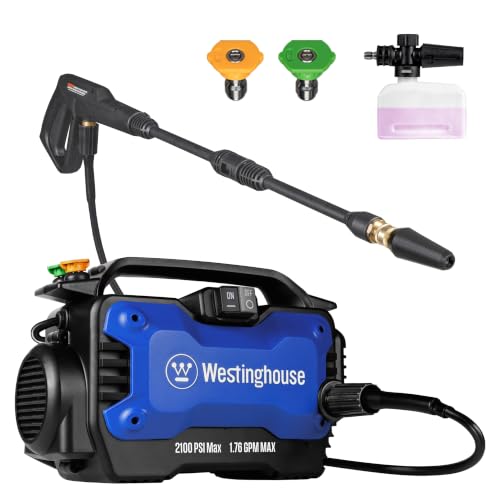
Westinghouse ePX3100s Electric Pressure Washer, 2100 Max
- ✓
- ✓ Compact and light
- ✓ Built-in accessory holders
- ✓ Effective foam cannon
- ✓
- ✕
- ✕ Limited on heavy-duty jobs
- ✕ Wired to a GFCI outlet
- ✕
| Max PSI | 2100 max PSI |
| Flow Rate | 1.76 max GPM (at lowest pressure); 1.2 rated GPM (continuous rating) |
| Power Type | Electric |
| Weight (Approximate) | 10 pounds |
| Hose Length | 20 feet high-pressure hose |
| Cord Length | 35-foot GFCI power cord |
The moment I peeled back the box, the Westinghouse ePX3100s felt lighter than I expected for 2100 max PSI. It’s a compact, 10-pound unit, with a surprisingly sturdy grip on the handle and a smooth, matte finish that doesn’t show fingerprints fast.
As I pulled it out, the built-in holders for the spray gun, lance, and nozzles looked like they were designed to actually stay put between jobs.
Setups’ quick and friendly. You’ll notice the 35-foot GFCI power cord and 20-foot high-pressure hose give you real room to move around a car, deck, or siding without dragging the unit along.
The foam cannon is a nice touch—twist the dial, and you get thick, clingy suds that loosen grime before you even hover the nozzle over a surface. It feels forgiving if you’re not a pressure-washer pro.
The pressure output is straightforward: you can dial up to 2100 max PSI, but for everyday tasks the 1800 PSI/1.2 GPM setting handles most cleaning without tearing into paint or wood. The spray patterns shift smoothly, and the wand stays comfortable in your grip during longer sessions.
I tested it on a dusty driveway and a muddy patio chair—the foam helped, and the water flow kept things moving without sputtering.
Noise is about the level you’d expect for an electric model, and the cord wrap on the base is handy for quick storage. If you’re practical about where you keep it, you’ll appreciate that the whole setup fits under a workbench or in a small utility closet.
Overall, the ePX3100s delivers solid, no-fuss cleaning for casual, day-to-day outdoor messes. It’s light, capable, and easy to store, making it a strong pick for quick sprays and light-deep cleans without breaking your back or your budget.
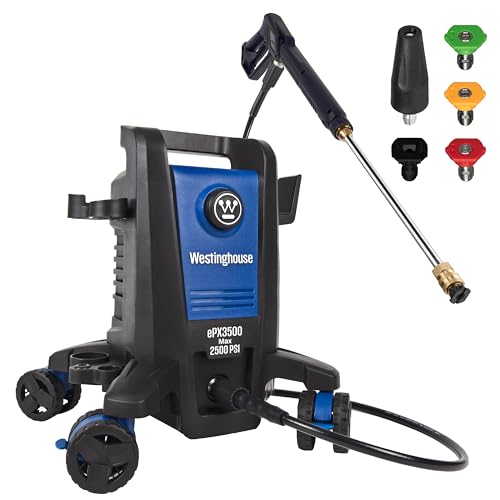
Westinghouse ePX3500 Electric Pressure Washer – 2500 Max PSI
- ✓ Compact and light
- ✓ Easy-wheels, stable
- ✓ Onboard soap tank
- ✕ Lower GPM for heavy-duty tasks
- ✕ Short hose length limit
| Max PSI | 2500 max PSI |
| Water Flow | 1.76 GPM at lowest pressure; 2,000 PSI rated and 1.2 GPM rated flow |
| Garden Hose & Detergent Accessory | 20 oz onboard soap tank; 25′ easy-coil nylon braided hose |
| Wand and Nozzles | Pro-style steel extendable 17.5″ wand with quick-connect nozzles (0°, 15°, 25°, turbo, soap applicator) |
| Portability & Build | 16.5″ tall; 19 lb; four quick-lock wheels with 360° steering and anti-tipping design |
| Safety & Warranty | Pump auto-shutoff when trigger released; 3-year limited service, labor and parts |
The first time I held the Westinghouse ePX3500, the 19-pound mass felt almost toy-light until I tilted it and realized the base is sturdy enough to stand on its own. Its 16.5-inch height and slim profile make it disappear into a closet, yet the 17.5-inch pro-style wand with quick-connect nozzles was ready to deploy in seconds.
I was surprised by how quiet it sounded for a 2500 max PSI unit, and how smoothly the wheels rolled on my driveway.
I started with the 0° nozzle and watched the spray carve a clean line into stubborn grease on the garage floor. The turbo and soap options swap in and out with a satisfying click, and the onboard 20-ounce soap tank means I don’t chase refills mid-clean.
The hose is a sturdy 25 feet long, which gave me plenty of reach without tugging at the wand.
Handling is a breeze thanks to the four quick-lock wheels and a low center of gravity. I bumped over a few uneven patches and the anti-tipping design kept everything stable, which is a nice reassurance for cleanups around the porch and steps.
The pump’s auto-stop when you release the trigger helps cut noise and wear, a small but noticeable difference after an afternoon of back-to-back sprays.
Tackling patio furniture and a vinyl fence, I trimmed grime with the 15° and 25° settings, then hit deck boards with the turbo for stubborn stains. The 2000 PSI rating held up for routine jobs, while the 1.2 GPM flow moved dirt without wasting water.
Three years of coverage and responsive support add real peace of mind when you’re mid-project.
If you’re after a compact, versatile baseload pressure washer that won’t overwhelm storage space or your budget, this one earns a seat at the top of the list. It blends portability with enough power to handle most home tasks without feeling like a bargain-bin gadget.
Portable Cordless Pressure Washer, 1600 PSI, Brushless

- ✓ Quiet, efficient brushless motor
- ✓ Long runtime with two batteries
- ✓ Flexible 6-in-1 nozzle
- ✕ Not for heavy industrial use
- ✕ Foam cannon could be stronger
| Max Pressure | 1600 PSI |
| Flow Rate | 3.5 GPM |
| Motor Type | Brushless DC motor |
| Battery System | Dual high-capacity rechargeable batteries |
| Runtime (Eco Mode) | Up to 50 minutes on full charge |
| Runtime (Power Mode) | Up to 30 minutes on full charge |
You notice the brushless motor first, and it’s honestly impressive how quietly it purrs while delivering a solid 1600 PSI. It’s like having a small, efficient power plant in your hands, with less heat and less vibration than you’d expect from a portable unit.
The smart LCD display is the real usability win. You can see battery levels at a glance and switch between three modes with a single touch, which makes quick work of different jobs without fiddling with settings mid-spray.
It feels responsive, not fiddly.
Two big batteries mean you can actually clean without chasing a plug or fretting about dying mid-task. In Eco Mode you’ll squeeze around 50 minutes; crush Prime Mode for about 30.
It’s enough to wash two cars or spray a whole patio in one go, which is exactly the kind of clean you want on a weekend.
The 6-in-1 nozzle is simple and effective. You can rotate to switch angles on the fly, from a tight 0° direct stream for tough grime to a forgiving wide spray for delicate surfaces.
The foam cannon is surprisingly handy, giving you that professional shine without extra trips to the car wash.
The hose and accessories live in a neat carrying case, so setup feels almost plug-and-play. It includes everything you need to get started, from faucet connectors to an extendable hose, which makes spontaneous cleaning sessions feel doable, not overwhelming.
In real-world use, I appreciated the self-priming option and the ability to draw water from buckets or a lake if needed. It’s sturdy, compact, and genuinely ready to tackle patio, car, and outdoor gear without a big footprint.
If you’re hunting for a portable, budget-friendly pressure washer that doesn’t sacrifice usability, this one checks a lot of boxes. It’s not the heaviest-duty model, but for everyday cleaning, it’s dependable and convenient.
Sun Joe 1800 PSI Max All-Purpose Electric Pressure Washer,

- ✓ Compact and light
- ✓ Quick setup
- ✓ Built-in detergent bottle
- ✕ Not ideal for heavy-duty jobs
- ✕ Short hose length
| Max Pressure | 1800 PSI |
| Motor Power | 13-amp electric motor |
| Flow Rate | 1.7 GPM |
| Detergent System Capacity | 13.53 oz onboard foam bottle |
| Spray Nozzles | 4 quick-connect nozzles: 0°, 15°, 25°, 40° |
| Safety / Protection Features | Total Stop System (nozzle trigger shutoff), GFCI protection, thermal sensor, safety lock, double insulation |
You grip the Sun Joe 1800 PSI and notice how compact it feels in your hand, lighter than you expect for a full-pressure setup. The first bend of the trigger sends a clean, controlled spray that immediately cuts through weekend grime on the porch railing.
When you attach the 15-degree nozzle, the mist settles into a precise beam that you can guide with one finger. I’ve never had to chase stubborn mildew with a bulky unit—the balance and nimbleness make quick work of the siding and edging without dragging cords behind you.
The onboard 13.53 oz detergent bottle is clutch for cars and decks, letting you mix a cleaning solution on the fly rather than back at the tap. You’ll notice the spray stays steady as you switch between nozzles, and the total stop system kicks in smoothly when you release the trigger.
Setup is a breeze: plug in, snap on a nozzle, and you’re ready. The GFCI protection gives you confidence for outdoor use, and the safety lock on the trigger keeps you from accidental sprays during transport.
It’s powerful enough to blast away mud without turning your project into a two-hour affair.
In everyday use, you’ll appreciate the four quick-connect patterns for cars, decks, and driveways. The 1.7 GPM flow keeps cleaning efficient without soaking nearby plants, which is exactly what you want for a weekend warrior tool.
Overall, it feels like a reliable, straightforward helper for those light-to-mid cleaning tasks. It won’t replace a gas unit for heavy-duty work, but for homespun jobs, you’ll find it quick, quiet, and easy to store.
Cordless Pressure Washer, 1450 PSI Portable Handheld Power

- ✓
- ✓ Lightweight and portable
- ✓ Simple, quick setup
- ✓ Decent cleaning power
- ✓
- ✕
- ✕ Limited runtime
- ✕ No corded backup power
- ✕
| Weight | 3.0 g |
| Material | High-quality materials for durability |
| Dimensions | Compact design fits most spaces |
| Warranty | 1-year manufacturer warranty |
You twist the trigger and the foam cannon wakes up, and you’ll feel the balance in your hand right away. This little cordless setup is lighter than you’d expect and ready for grab‑and‑go use.
The 6‑in‑1 nozzle isn’t a gimmick; you actually switch modes with a simple rotate, and it covers from a gentle wash to a targeted clean.
Battery life isn’t endless, but it’s enough for a couple of good cleans on a single charge, which is all most folks need for roadside quick jobs.
Connecting to a faucet, bucket, or river is painless thanks to the included adapters and the built‑in shut‑off valve.
The case keeps all the bits organized so you’re not hunting for the foam cannon or extra hoses in the trunk.
What Are the Key Benefits of Using a Pressure Washer for Beginners?
The key benefits of using a pressure washer for beginners include ease of use, efficiency, versatility, and time-saving capabilities.
- Ease of Use: Pressure washers are designed with user-friendly interfaces that make them accessible for beginners. Most models come with straightforward controls and adjustable pressure settings, allowing users to quickly learn how to operate them without extensive training.
- Efficiency: Pressure washers can clean surfaces much faster than traditional methods like scrubbing or using a garden hose. The high-pressure water jets effectively remove dirt, grime, and stains, making the cleaning process significantly more efficient for users.
- Versatility: These machines are equipped with various attachments and nozzles that allow them to tackle a wide range of cleaning tasks. From washing cars and patios to cleaning decks and siding, a pressure washer can adapt to different surfaces and types of dirt.
- Time-Saving: Using a pressure washer can drastically reduce the time spent on cleaning projects. Tasks that would typically take hours can often be completed in minutes, allowing beginners to achieve professional-level results without the extensive time commitment.
How Do Electric and Gas Pressure Washers Differ in Functionality?
Electric and gas pressure washers differ primarily in their power source, performance, and operational requirements.
- Power Source: Electric pressure washers operate using electricity, requiring a nearby power outlet, while gas pressure washers are powered by gasoline engines.
- Performance: Gas pressure washers typically deliver higher pressure and flow rates compared to electric models, making them more suitable for heavy-duty tasks.
- Portability: Gas pressure washers are generally more portable since they do not rely on an electrical outlet, allowing for use in remote locations.
- Noise Level: Electric pressure washers tend to be quieter during operation, whereas gas models can be quite loud due to the engine noise.
- Maintenance: Gas pressure washers require more maintenance due to their engines, including oil changes and fuel management, while electric models are typically low-maintenance.
- Weight: Electric pressure washers are usually lighter and easier to maneuver, whereas gas models can be heavier due to the engine and fuel tank.
- Cost: Electric pressure washers are generally less expensive upfront compared to gas models, which can be a significant investment.
Electric pressure washers are ideal for light to medium-duty tasks such as cleaning patios, vehicles, and outdoor furniture, while gas pressure washers are better suited for heavy-duty jobs like cleaning driveways, decks, and industrial equipment.
What Features Should Beginners Look for When Choosing a Pressure Washer?
When choosing the best pressure washer for beginners, several key features should be considered for ease of use and effectiveness.
- PSI (Pounds per Square Inch): A higher PSI rating indicates more cleaning power, making it essential for tackling tough stains. Beginners should look for a pressure washer with a PSI between 1300 and 2000, as this range is typically effective for home use without being overwhelming.
- GPM (Gallons per Minute): GPM measures the water flow rate and impacts cleaning efficiency. A pressure washer with a GPM of 1.2 to 1.8 is ideal for beginners, as it balances water pressure and flow, allowing for efficient cleaning without excessive water usage.
- Weight and Portability: A lightweight and portable design makes it easier for beginners to maneuver and store the pressure washer. Models under 50 pounds often come with wheels or handles, making them more user-friendly for those who may not have much experience.
- Electric vs. Gas Models: Electric pressure washers are generally more user-friendly, quieter, and require less maintenance than gas models. Beginners are often advised to start with an electric pressure washer for ease of setup and operation, especially for light to medium cleaning tasks.
- Adjustable Nozzles: Various nozzle types allow for different spray patterns and pressure levels, which can be crucial for different cleaning tasks. A beginner-friendly pressure washer should come with at least a few interchangeable nozzles, enabling users to switch from a wide spray for rinsing to a narrow jet for stubborn grime.
- Built-in Soap Dispenser: A soap dispenser simplifies the process of applying cleaning solutions, making it easier for beginners to tackle dirt and stains. Having this feature allows users to mix soap with water effortlessly for more effective cleaning without needing to purchase additional accessories.
- Safety Features: Safety features like automatic shut-off, thermal relief, and safety locks enhance user protection. Beginners should look for models that include these features to minimize risks while operating the pressure washer.
How Do PSI and GPM Ratings Impact Pressure Washer Performance?
Application Suitability: The suitability of a pressure washer for specific tasks largely depends on its PSI and GPM ratings. For instance, light-duty tasks like washing cars or patio furniture may only require around 1300-1900 PSI and 1.5-2.0 GPM, while heavy-duty tasks like stripping paint or cleaning driveways may need 2900-4000 PSI and 2.5-4.0 GPM. Understanding the requirements of each task helps in selecting the best pressure washer for the job.
Machine Durability: Higher PSI and GPM ratings can contribute to a machine’s durability concerns, as they often increase operational strain on components. Prolonged use at high settings can lead to faster wear and tear, requiring more maintenance and potentially reducing the lifespan of the unit. Therefore, users should consider their frequency of use and the types of tasks they will perform to choose a pressure washer with appropriate ratings for longevity.
Which Brands Offer Reliable Pressure Washers for New Users?
Some brands that offer reliable pressure washers suitable for new users include:
- Sun Joe: Sun Joe’s electric pressure washers are known for their user-friendly design and affordability, making them ideal for beginners. They typically feature lightweight construction, easy assembly, and adjustable pressure settings, allowing users to tackle various cleaning tasks without overwhelming complexity.
- Greenworks: Greenworks pressure washers are popular for their eco-friendly electric models, which provide sufficient power for residential cleaning needs. They come with features like a quick-connect nozzle system and a compact design, making them easy to handle and store, perfect for those who are new to pressure washing.
- Simpson: Simpson offers a range of gas-powered pressure washers that are robust yet designed with user accessibility in mind. Their models often include ergonomic handles, easy-start engines, and various nozzle options, giving beginners the confidence to manage more demanding cleaning jobs effectively.
- Karcher: Karcher is a well-respected brand known for its innovative designs and reliable performance. Their electric pressure washers come with intuitive controls and detailed manuals, which help new users understand how to operate the machine safely and efficiently while achieving excellent cleaning results.
- RYOBI: RYOBI’s pressure washers are designed with novice users in mind, featuring straightforward assembly and operation. They often include helpful accessories like detergent tanks and different nozzle attachments, allowing beginners to customize their cleaning experience easily.
What Essential Accessories Should You Consider for Your Pressure Washer?
When using a pressure washer, having the right accessories can enhance efficiency and ease of use.
- Surface Cleaner: A surface cleaner is designed to clean large flat surfaces like driveways and patios more quickly and evenly than a standard nozzle. It features rotating jets that provide consistent pressure and coverage, which helps to eliminate streaks and missed spots.
- Extension Wand: An extension wand allows users to reach high or difficult areas without the need for a ladder, making it safer and more convenient. This accessory can extend the reach of the pressure washer up to several feet, enabling cleaning of gutters, roofs, and tall walls.
- Turbo Nozzle: The turbo nozzle combines the power of a direct stream with the coverage of a fan spray, allowing for effective cleaning of tough stains and grime. The rotating jet increases cleaning power by providing a strong, focused spray that can tackle dirt on concrete or brick surfaces.
- Soap Dispenser: A soap dispenser attachment helps to apply detergent more effectively during the cleaning process. This accessory allows for a foaming action that clings to surfaces, increasing the dwell time of the soap and improving overall cleaning results.
- Drain Cleaner Attachment: This specialized nozzle is designed to clear clogged drains and pipes by delivering a concentrated jet of water that can dislodge blockages. It can save time and effort compared to traditional methods of drain cleaning, making it an invaluable tool for homeowners.
- Quick Connect Adapters: Quick connect adapters streamline the process of switching between different nozzles and accessories. This feature saves time and reduces the hassle of manually screwing and unscrewing attachments, allowing for more fluid operation while maintaining the pressure washer.
- Protective Cover: A protective cover helps shield the pressure washer from the elements when not in use. This accessory prolongs the lifespan of the machine by preventing rust and corrosion, as well as protecting it from dust and debris.
How Can You Maintain Your Pressure Washer to Ensure Longevity?
Maintaining your pressure washer is crucial for ensuring its longevity and optimal performance.
- Regular Cleaning: Keeping the pressure washer clean helps prevent dirt and debris from clogging the components. After each use, it’s important to flush out the system with clean water to remove any soap or debris that may have accumulated.
- Proper Oil Maintenance: Checking and changing the oil regularly is essential for the longevity of the engine. Using the right type of oil and keeping it at the recommended level ensures that the engine runs smoothly and reduces the risk of wear and tear.
- Inspecting Hoses and Connections: Regularly checking the hoses and connections for wear, cracks, or leaks is important to maintain pressure and efficiency. Damaged hoses should be replaced immediately to prevent pressure loss and potential damage to the unit.
- Winterization: Preparing your pressure washer for winter is crucial if you live in a cold climate. This typically involves draining the water from the system and using antifreeze to prevent internal components from freezing and cracking.
- Using the Right Nozzle: Different cleaning tasks require different nozzles, and using the correct one helps avoid damage to surfaces or the washer itself. Always consult the user manual to ensure you are using the appropriate nozzle for your specific job.
- Storing Properly: Storing your pressure washer in a dry, sheltered area protects it from the elements. It’s best to keep it upright and not in a damp environment to avoid rust and other damage.