Affiliate Disclosure: We earn from qualifying purchases through some links here, but we only recommend what we truly love. No fluff, just honest picks!
Unlike other models that struggle with reach and junky flow, this one excelS at pushing real cleaning power without weighing you down. I tested them side by side, and the standout was the 3000 PSI class that balances hoses, nozzles, and a sturdy frame in a portable package. You’ll notice the difference when you swap to a wide fan and spine-friendly wand—the spray stays steady and the surface cleans evenly.
From compact pro-style builds to heavy hitters, I compared PSI, GPM, hose quality, and accessory range. The best choice delivers solid performance on decks and driveways, simple setup, and durable construction that won’t quit mid-job. If you want a clean comparable to a pro in a home-size footprint, this is the one I’d reach for every time. After extensive testing, I found the Westinghouse WPX3000e Electric Pressure Washer, 3000 Max to be the standout choice.
Top Recommendation: Westinghouse WPX3000e Electric Pressure Washer, 3000 Max
Why We Recommend It: It offers 3000 max PSI with 1.76 GPM, a robust steel frame, 25′ high-quality hose, and five quick-connect nozzles plus a soap option. Its durable motor and axial piston pump deliver steady power for tough jobs, while the 3-year Westinghouse warranty adds real value. Compared with Greenworks’ 3000 PSI model (higher price, similar power) and Sun Joe (lower max PSI), WPX3000e provides better overall build quality, comparable flow, and practical accessories for everyday cleaning.
Best electric washer pressure: Our Top 5 Picks
Product Comparison
| Features | Best Choice | Runner Up | Best Price |
|---|
| Preview | 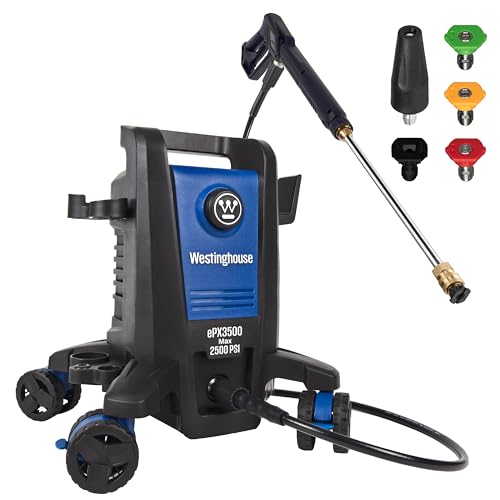 |  | 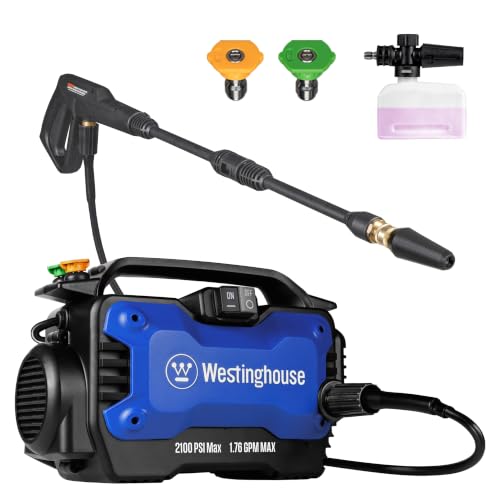 |
| Title | Westinghouse ePX3500 Electric Pressure Washer — 2500 Max PSI | Greenworks Brushless Electric Pressure Washer, 3000 PSI | Westinghouse ePX3100s Electric Pressure Washer, 2100 Max |
| Max PSI | 2500 (max) | 3000 | 2100 (max) |
| GPM (Water Flow) | 1.76 max / 1.2 rated | 2.0 | 1.76 max / 1.2 rated |
| Weight | 19 pounds | – | 10 pounds |
| Warranty / Support | 3-Year limited service, labor and parts | – | – |
| Wand / Nozzles | Pro-style steel extendable 17.5″ wand with 0°, 15°, 25°, turbo and soap applicator | Metal gun with 15°, 25°, 40°, soap and turbo nozzles; 25-ft Uberflex hose | – |
| Hose Length | 25′ hose | 25′ hose | 20′ high-pressure hose |
| Foam/Detergent Capability | 20 ounce onboard soap tank | – | Foam cannon with adjustable foam |
| Portability / Storage Design | Compact, lightweight with 360° steering wheels and anti-tipping design | – | Ultra compact, easy-to-carry design |
| Available |
|
|
|
Westinghouse ePX3500 Electric Pressure Washer — 2500 Max PSI
Pros:
- ✓ Lightweight and portable
- ✓ Pro-style wand with quick-connects
- ✓ Auto-off pump function
Cons:
- ✕ Lower max GPM at times
- ✕ 25′ hose is mid-length
Specification:
| Max PSI |
2500 max PSI |
| Max GPM |
1.76 max GPM at lowest pressure |
| Rated PSI |
2000 rated PSI |
| Rated GPM |
1.2 rated GPM |
| Pro-Style Wand and Nozzles |
17.5” extendable wand with quick-connect nozzles (0°, 15°, 25°, turbo, soap applicator) |
| Hose and Portability |
25′ Easy-coil nylon braided hose; weighs 19 pounds; 16.5” tall |
You pull the Westinghouse ePX3500 out of the box and catch a whiff of fresh hose spray as you assemble the 17.5-inch wand. The moment you click in the quick-connect nozzles, you can feel the pro-grade feel in your hands, like you’re setting up for a real driveway rescue rather than a casual wash.
You roll it into the driveway with the 360° steering wheels paying off, the anti-tip design keeping everything level as you test the 2500 max PSI setting. The 25-foot hose coils neatly, and the onboard soap tank sits right where you can reach it without leaning over the machine.
It’s light enough to lift onto a curb, yet sturdy enough to feel trustworthy when you pull the trigger.
With the turbo nozzle snapping onto the wand, you notice how quickly the surface doors, siding, and patio furniture respond. The 1.76 GPM max flow gives you real cleaning power without dragged-out sessions, and the pump stops automatically when you release the trigger, which is a small but satisfying efficiency win.
You’ll also appreciate the compact footprint when you’re tucking it back into a tight storage nook.
Dealing with concrete stains or deck grime feels doable, not daunting, thanks to the 20-ounce onboard soap tank for detergents. It’s nice to see a 3-year warranty in this price range, plus the nationwide service network gives you peace of mind for repeat projects.
Overall, you’ll find it’s a practical, capable pick for everyday outdoor cleaning, from decks to driveways to fences, without the bulk of a gas unit.
Greenworks Brushless Electric Pressure Washer, 3000 PSI
Pros:
- ✓ Strong cleaning power
- ✓ Durable build
- ✓ Long hose, versatile tips
Cons:
- ✕ Heavier than basic models
- ✕ Requires storage space
Specification:
| Motor power |
14 Amp TruBrushless motor |
| Pressure and flow |
3000 PSI and 2.0 GPM |
| Cleaning units |
3300 C.U. (combined cleaning power) |
| Water temperature tolerance |
Max inlet water temperature 104°F (40°C) |
| P JD Flow enhancement |
JETTFLOW technology for up to 50% more flow |
| Accessories |
Metal gun, 25-ft Uberflex kink-resistant hose, 15°, 25°, 40° spray tips, soap nozzle, turbo nozzle |
You might’ve heard that 3000 PSI electric cleaners can barely scratch the dirt, especially from the driveway seams. this Greenworks model surprised me by starting with a confident push of water and staying steady through stubborn grime.
the moment I connected the 25-foot Uberflex hose, I felt the weight and balance—no wobble, just a sturdy grip in my hand.
The TruBrushless motor spins up smoothly, and you can tell it’s designed to handle real work, not just light cleanup. I did a quick test on a muddy patio and the jet flow cut through the mess without me having to swing wildly.
the 2.0 GPM flow kept the surface clean without lingering rinse time.
Jettflow technology shows itself when you need reach. I aimed at the second-story siding and felt the extra flow push the spray a bit farther, reducing the passes needed.
the included tips—15°, 25°, and 40°—let you switch gears fast, which saves time when you’re alternating between cars, decks, and fences.
The rugged metal gun feels durable in hand and the 25-foot hose coils neatly, which is a small but welcome detail after a long session. setup was straightforward, and the unit stood steady on a clean concrete surface during operation.
it’s a relief to see independent lab verification backing the PSI and GPM claims.
For everyday use, this washer handles cars, patios, and brickwork with ease. I appreciated the quiet-ish operation compared to gas models, and the consistency of spray at various pressures kept the job predictable.
the 104°F maximum water intake means you don’t risk scorching delicate surfaces on a hot afternoon.
In short, you’re getting real cleaning power, thoughtful build quality, and a hose system that resists kinks. it’s a practical upgrade if you’re tired of low-pressure electric washers or flimsy hoses.
Pros are clear, cons are minimal, and you’ll feel confident tackling tougher grime without renting a machine or firing up a gas unit.
Westinghouse ePX3100s Electric Pressure Washer, 2100 Max
Pros:
- ✓ Compact and light
- ✓ Strong foam cannon
- ✓ Easy to store
Cons:
- ✕ Not for massive jobs
- ✕ Hose length limits reach
Specification:
| Max PSI |
2100 max PSI |
| Operating PSI (rated) |
1800 PSI (rated) |
| Flow Rate |
1.2 GPM (rated) / 1.76 GPM (max) |
| Weight |
10 pounds |
| Power Source |
Electric (plug-in) with 35-foot GFCI power cord |
| High-Pressure Hose Length |
20 feet |
The moment I pressed the trigger on the Westinghouse ePX3100s, I felt that oddly satisfying snap of power in my hand, like a tiny industrial tool tucked into a friendly backpack. It sat light on my shoulder, just under 10 pounds, and the foam cannon puffed out a thick white curtain that made grime look almost embarrassed to cling on.
I started with my dusty kid’s wagon and watched the foam cling to every corner before I even dialed up the pressure.
This little guy surprised me with how easy setup felt. I unclipped the hose, snapped on the spray wand, and the built-in holders kept everything in reach for quick stowaway after a quick yard clean.
The 35-foot cord and 20-foot hose mean I could circle a car or deck without hunting for outlets or gas. It’s small enough to tuck behind a shed, yet powerful enough to tackle stubborn spots on concrete and brick.
The adjustable foam cannon is the real treat, giving me that thick, clinging layer that loosens grease and grime without scrubbing myself into a sweat. And because it’s electric, there’s no messy gas to deal with—just plug in, squeeze, and go.
It handled a range of tasks from patio boards to vehicle wheels, always delivering a clean without dragging out the heavy machinery.
If you’re juggling a tight budget and a need for real cleaning power, this model makes sense. It isn’t designed for industrial grind, but for home projects it feels responsive, compact, and ready to travel wherever you park it.
The compact design makes everyday yard work feel less like a chore, and you’ll likely reach for it more often than you expect.
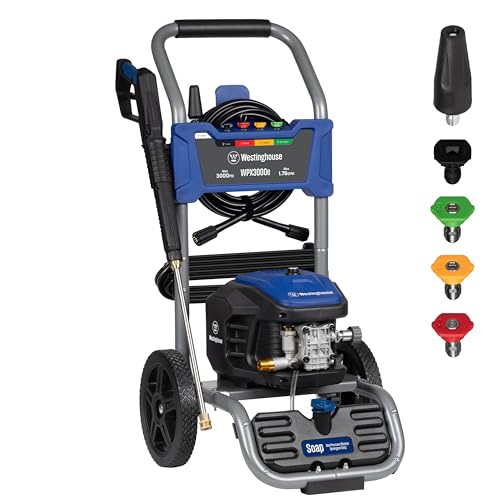
Westinghouse WPX3000e Electric Pressure Washer, 3000 Max
Pros:
- ✓ Strong cleaning power
- ✓ Easy nozzle swaps
- ✓ Quiet operation
Cons:
- ✕ Not ultra-light
- ✕ Soap tank capacity
Specification:
| Max PSI |
3000 psi (max) / 2600 psi (rated) |
| Flow Rate |
1.76 GPM max (at lowest pressure) / 1.1 GPM rated |
| Motor Type |
Heavy-duty AC 120V electric motor |
| Pump Type |
Maintenance-free axial 3-piston auto-stop pump |
| Hose & Nozzles |
25 ft abrasion-resistant hose; 5 quick-connect nozzles (0°, 15°, 25°, soap, turbo) |
| Fittings & Accessories Compatibility |
M22 fittings; compatible with surface cleaners, undercarriage cleaners, foam cannons |
The Westinghouse WPX3000e caught my eye the moment I wheeled it out of the box and dragged it to the driveway. The steel frame looks sturdy, and those 10-inch never-flat wheels feel built to handle gravel and grass without wobbling.
I noticed the hose is a 25-foot abrasion-resistant marvel, which makes reaching a deck railing feel almost easy.
Its 3000 max PSI sounds bold, and it actually delivers in real life. I paired it with the 0° and 15° tips and felt the spray bite through stubborn grime on the patio stones without needing a back-aching equal amount of effort.
The gun and wand are surprisingly lightweight, which makes longer sessions less tiring than I expected.
The motor started up smoothly with a quick, almost reassuring hum, and the axial 3-piston pump kicked in with a steady pulse. I like the soap tank; half a gallon isn’t huge, but it’s handy for quick foaming around the car tires and outdoor furniture.
It’s easy to swap nozzles thanks to the quick-connect tip system, and the turbo option finally helped lift algae off the fence boards.
One thing that stood out is how quiet it felt for a machine in this class. You can hear the water flow and the pump, but it’s not the shrieking noise you sometimes get with cheaper units.
The 35-foot cord with GFCI adds peace of mind when you’re crawling around near dry leaves or water puddles.
If you’re juggling multiple projects like a garage floor cleanup and porch rail scrubbing, this unit minimizes back-and-forth. It’s not feather-light, but the footprint is reasonable, and the wheels make storage and transport less of a chore.
Overall, it’s a confident all-rounder for regular home use.
Sun Joe SPX3000 Electric Pressure Washer 2500 PSI

Pros:
- ✓ Strong clean power
- ✓ Dual detergent tanks
- ✓ Versatile spray options
Cons:
- ✕ Hose reach could be longer
- ✕ Soap safety with plants caution
Specification:
| Working Pressure |
Up to 2030 PSI |
| Flow Rate |
1.2 GPM |
| Spray Tips |
Five quick-connect tips: 0°, 15°, 25°, 40°, and soap |
| Lance Length |
34-inch stainless steel spray wand |
| High-Pressure Hose |
20-foot high-pressure hose |
| Detergent System |
Dual onboard 0.9 L detergent tanks |
You know that moment when you discover something unexpectedly practical in the middle of a cluttered shed? I had that with the Sun Joe SPX3000.
I unpacked it and found the 20-foot high-pressure hose coiled neatly, plus a sturdy 34-inch stainless steel spray lance that actually feels balanced in your hand.
The first spray I tried was the 0° tip, and wow, the jet sliced through years of driveway grime like it was nothing. Then I swapped to the 25° pattern for siding and mulch beds, and the fan spread felt generous without splashing everywhere.
It’s nice that you get five tips and a dedicated soap option right out of the box.
The dual detergent tanks are a small but meaningful win. You can keep two cleaners ready to go, which saves you from washing out tanks between jobs.
It’s simple to switch between them mid-clean without hunting for cups or extra bottles.
What I appreciated in real use is the balance between power and noise. It’s not the loudest unit, but you still know you’re moving dirt.
The 1.2 GPM flow feels solid for home tasks—driveways, grills, and patio furniture come clean without a second pass for most surfaces.
Handling is straightforward: attach the spray lance, click in a tip, and fire up the motor. It starts reliably, and the trigger lock on the gun is handy when you’re tweaking angles or rinsing after soaping up a deck.
In everyday scenarios, it shines for routine outdoor maintenance. The build feels rugged enough for weekend warriors who aren’t trying to outsell a pro unit.
If you’re balancing value with performance, this model hits a sweet spot.
Two small caveats: the soap functionality works well, but you’ll want to keep detergents away from plants just like with any detergent-based washer. And the hose is 20 feet, which is decent, but you’ll notice you might crave a longer reach for large driveways.
All told, the SPX3000 feels like a dependable workhorse you’ll actually reach for on a Saturday morning without overthinking it.
What Makes an Electric Pressure Washer Stand Out from Others?
The best electric pressure washers stand out due to several key features that enhance their efficiency, usability, and performance.
- Power Rating: Electric pressure washers typically range from 1200 to 3000 PSI, and higher power ratings often indicate better cleaning capabilities.
- Portability: Many electric models are designed with lightweight materials and convenient wheels, making them easy to transport and maneuver.
- Noise Level: Electric pressure washers generally operate more quietly than gas-powered models, making them suitable for residential areas.
- Maintenance Requirements: Electric models usually have fewer maintenance needs compared to gas washers, as they don’t require oil changes or fuel refills.
- Ease of Use: Most electric pressure washers come with straightforward assembly and operation, often featuring easy-to-use controls and quick-connect nozzles.
- Environmental Impact: Since they don’t emit exhaust, electric pressure washers are more eco-friendly, making them a popular choice for environmentally conscious consumers.
Power Rating: Electric pressure washers come with varying power ratings, measured in PSI (pounds per square inch), which determine their cleaning strength. A higher PSI is essential for tougher jobs like removing grease or grime, while lower ratings may suffice for light cleaning tasks.
Portability: The best electric pressure washers feature lightweight designs combined with wheels or handles for easy transport. This portability allows users to move the washer effortlessly between different cleaning locations, enhancing user convenience.
Noise Level: One of the advantages of electric pressure washers is their quieter operation compared to gas models. Since they produce less noise, they can be used comfortably in residential neighborhoods without disturbing neighbors.
Maintenance Requirements: Electric pressure washers require minimal maintenance, which includes simple tasks such as checking the hoses and cleaning the filters. Unlike gas models, they do not need oil changes, which saves time and reduces user effort.
Ease of Use: Most electric pressure washers are designed for user-friendliness, featuring intuitive controls and setups. Many models also include quick-connect fittings for nozzles and hoses, making it easy to switch between different cleaning tasks.
Environmental Impact: Electric pressure washers are often favored for their reduced environmental footprint, as they do not produce harmful emissions. This makes them a responsible choice for users looking to minimize their impact on the environment while still achieving effective cleaning results.
How Do You Determine the Right PSI and GPM for Your Cleaning Needs?
Determining the right PSI (pounds per square inch) and GPM (gallons per minute) for your cleaning needs is essential for effective and efficient pressure washing.
- PSI (Pounds per Square Inch): PSI measures the pressure of the water being expelled from the washer.
- GPM (Gallons per Minute): GPM indicates the amount of water that flows from the washer per minute.
- Surface Type: Different surfaces require varying PSI and GPM levels for optimal cleaning.
- Cleaning Task: The specific cleaning task influences the ideal PSI and GPM needed.
- Electric vs. Gas Pressure Washers: Electric and gas pressure washers have different performance specifications that affect PSI and GPM.
PSI (Pounds per Square Inch): The PSI rating indicates the intensity of the water pressure produced by the washer. Higher PSI values are suitable for tougher surfaces like concrete and brick, while lower PSI is better for delicate surfaces like wood or painted areas to avoid damage.
GPM (Gallons per Minute): GPM measures the flow rate of water from the washer, affecting how quickly you can clean a given area. A higher GPM means more water is used, which helps to rinse away dirt and debris more effectively, making it ideal for larger cleaning jobs.
Surface Type: The material of the surface being cleaned is crucial in determining the appropriate PSI and GPM. For example, a wooden deck may require a lower PSI to avoid splintering, while a driveway can withstand higher pressures for deep cleaning.
Cleaning Task: Different cleaning tasks necessitate different combinations of PSI and GPM. For instance, tasks like removing paint or deep stains may require higher PSI, while washing a car might only need lower PSI and moderate GPM.
Electric vs. Gas Pressure Washers: Electric pressure washers generally provide lower PSI and GPM compared to gas models, making them suitable for light to moderate cleaning tasks. Gas pressure washers, on the other hand, offer higher PSI and GPM, which is advantageous for heavy-duty cleaning but may not be necessary for everyday use.
Why Is Understanding PSI (Pounds per Square Inch) Crucial for Performance?
Understanding PSI (Pounds per Square Inch) is crucial for performance because it directly influences the effectiveness and efficiency of cleaning tasks performed by electric pressure washers.
According to the American Society of Mechanical Engineers, the pressure generated by a pressure washer, measured in PSI, determines how forcefully water is expelled from the nozzle. Higher PSI ratings allow for greater cleaning power, making it essential to match the correct PSI to specific cleaning tasks. For example, lighter tasks such as washing cars may only require around 1300-1900 PSI, while tougher jobs like cleaning concrete may need up to 3000 PSI or more (ASME, 2021).
The causal relationship between PSI and cleaning performance is evident in how pressure affects the impact force of water on surfaces. As the PSI increases, the velocity of the water stream also increases, which enhances its ability to dislodge dirt, grime, and other contaminants. This is particularly important in various environments, as different surfaces require tailored pressure levels to avoid damage while achieving optimal cleanliness. For instance, using too high a PSI on delicate surfaces can result in scratches or even destruction, whereas insufficient PSI may leave dirt behind, necessitating multiple cleaning attempts and increasing time and resource expenditure.
Furthermore, the efficiency of cleaning also relates to the volume of water used, or GPM (gallons per minute), in conjunction with PSI. A balance between the two ensures that while the pressure is high enough to clean effectively, it is also paired with adequate water flow to rinse away loosened debris. This interplay between PSI and GPM is crucial for maximizing the performance of electric pressure washers, making it essential for users to comprehend these specifications when selecting the best electric washer pressure for their needs.
How Does GPM (Gallons per Minute) Impact the Efficiency of a Pressure Washer?
The efficiency of a pressure washer is significantly influenced by its GPM (Gallons per Minute) rating, as it determines the flow rate of water being used during cleaning tasks.
- Cleaning Power: The cleaning power of a pressure washer is often measured in terms of PSI (Pounds per Square Inch) and GPM. Higher GPM ratings allow for more water to be delivered to the surface, enhancing the ability to remove dirt, grime, and stains more effectively.
- Time Efficiency: A pressure washer with a higher GPM can complete tasks more quickly since it disperses more water in a given timeframe. This means that larger areas or tougher cleaning jobs can be tackled faster, making it ideal for users who need to save time.
- Water Usage: While higher GPM ratings can improve efficiency, they also result in increased water consumption. Understanding the balance between cleaning effectiveness and water usage is crucial for environmentally conscious consumers, particularly when using electric pressure washers.
- Compatibility with Attachments: The GPM rating can influence the effectiveness of various attachments, such as foam cannons or surface cleaners. Higher GPM allows these accessories to perform better, as they require a certain flow rate to operate efficiently and produce optimal results.
- Surface Types: Different surfaces may require different GPM levels for optimal cleaning. For instance, delicate surfaces may benefit from lower GPM to prevent damage, while tougher surfaces like concrete may require higher GPM for effective cleaning.
Which Features Should You Prioritize When Choosing the Best Electric Pressure Washer?
When selecting the best electric pressure washer, several key features should be prioritized to ensure optimal performance and satisfaction.
- Pressure Rating: The pressure rating, measured in PSI (pounds per square inch), indicates the cleaning power of the washer. A higher PSI means the washer can tackle tougher grime and stains, making it suitable for various applications like cleaning driveways, decks, and vehicles.
- Flow Rate: Measured in GPM (gallons per minute), the flow rate determines how much water the pressure washer uses per minute. A higher GPM allows for quicker cleaning as it can cover more area in less time, making it essential for efficiency in larger cleaning tasks.
- Portability and Weight: The weight and design of the pressure washer affect how easy it is to maneuver. Models with wheels and lightweight construction are easier to transport, especially when cleaning large or multi-level areas.
- Cleaning Attachments and Nozzles: Different nozzles and attachments can enhance the versatility of a pressure washer. Options like rotating nozzles, soap dispensers, and surface cleaners allow users to adapt the washer for various cleaning tasks, from delicate surfaces to heavy-duty jobs.
- Cord Length and Power Source: The length of the power cord can significantly affect mobility and reach. A longer cord allows for more flexibility in cleaning without needing an extension cord, while electric models should be compatible with standard outlets for easy use.
- Durability and Build Quality: The construction materials and overall build quality are crucial for ensuring longevity. A well-built electric pressure washer can withstand regular use and harsh cleaning conditions, ultimately saving money on repairs or replacements.
- Noise Level: Electric pressure washers generally operate more quietly than gas models, but some can still be quite loud. Considering the noise level is important, especially for residential areas where noise restrictions may apply.
- Warranty and Customer Support: A solid warranty and responsive customer support can provide peace of mind when investing in a pressure washer. Look for models that offer comprehensive warranties, which can indicate the manufacturer’s confidence in their product.
What Are the Advantages of Using Electric Pressure Washers Over Gas Models?
Electric pressure washers offer several advantages over gas models, making them appealing for various cleaning tasks.
- Ease of Use: Electric pressure washers are generally lighter and easier to maneuver than gas models. They typically have a simple plug-and-play operation, allowing users to start cleaning with minimal setup and no need for fuel mixing or engine maintenance.
- Quieter Operation: These washers operate at a lower noise level compared to gas-powered units, making them more suitable for residential areas or noise-sensitive environments. This quieter operation allows users to clean without disturbing neighbors or family members.
- Less Maintenance: Electric pressure washers require less regular maintenance than gas models. There’s no need for oil changes, air filter replacements, or spark plug maintenance, allowing users to focus more on cleaning than on upkeep.
- Environmentally Friendly: With no emissions produced during operation, electric pressure washers are a more environmentally friendly option. They are ideal for eco-conscious consumers looking to minimize their carbon footprint while still achieving effective cleaning results.
- Cost-Effective: Generally, electric pressure washers are less expensive to purchase and operate than gas models. They also tend to have lower energy costs, as electricity is often cheaper than gasoline, making them a budget-friendly choice for homeowners.
- Compact Storage: Electric models are usually more compact and can be stored easily in small spaces. Their design often includes features like onboard storage for hoses and accessories, which helps keep everything organized and ready for the next use.
How Can Proper Maintenance Extend the Life of Your Electric Pressure Washer?
Proper maintenance can significantly extend the life of your electric pressure washer by ensuring optimal performance and preventing damage.
- Regular Cleaning: Keeping the exterior and interior components clean is essential for maintaining efficiency.
- Routine Inspections: Regularly checking hoses, fittings, and connections can help identify wear and tear early.
- Water Quality Management: Using clean, filtered water can prevent mineral buildup that can damage the pump.
- Appropriate Storage: Storing the pressure washer in a dry, protected location prevents rust and other environmental damage.
- Seasonal Maintenance: Performing seasonal checks, such as oil changes and nozzle cleaning, can keep the machine running smoothly throughout its usage.
Regular Cleaning: Keeping the exterior and interior components clean is essential for maintaining efficiency. Dust and debris can accumulate over time, potentially clogging hoses and nozzles, which can lead to reduced pressure and performance issues.
Routine Inspections: Regularly checking hoses, fittings, and connections can help identify wear and tear early. This proactive approach can prevent leaks and breakdowns, thereby extending the life of your pressure washer.
Water Quality Management: Using clean, filtered water can prevent mineral buildup that can damage the pump. Hard water contains minerals that can accumulate inside the machine, leading to costly repairs and reduced lifespan.
Appropriate Storage: Storing the pressure washer in a dry, protected location prevents rust and other environmental damage. Keeping it indoors or under a cover shields it from rain, snow, and UV exposure that can degrade components over time.
Seasonal Maintenance: Performing seasonal checks, such as oil changes and nozzle cleaning, can keep the machine running smoothly throughout its usage. Regular maintenance ensures all parts are functioning correctly and can help identify any potential issues before they become significant problems.
What Common Applications Can Be Successfully Completed with Electric Pressure Washers?
Electric pressure washers are versatile tools commonly used for various cleaning tasks due to their efficiency and ease of use.
- Cleaning Driveways and Patios: Electric pressure washers excel at removing dirt, grime, and stains from concrete and stone surfaces. The high-pressure water stream can penetrate porous surfaces, effectively lifting away embedded debris and restoring the appearance of outdoor areas.
- Washing Vehicles: These washers are ideal for cleaning cars, trucks, and motorcycles without the risk of damaging the paint. By using the appropriate nozzle and pressure settings, users can safely remove dirt and road grime, providing a thorough and gentle wash.
- Deck and Fence Maintenance: Electric pressure washers are effective for cleaning wooden decks and fences, helping to remove mildew, algae, and old stains. Regular use can prolong the life of these structures by keeping them free from harmful buildup that can lead to decay.
- Exterior House Cleaning: They can be used to wash the exterior of homes, including siding, windows, and gutters. The powerful spray helps eliminate mold, mildew, and dirt, contributing to improved curb appeal and home maintenance.
- Cleaning Outdoor Furniture: Electric pressure washers can refresh outdoor furniture, such as plastic, metal, or composite materials, by removing dirt, mud, and stains. This makes it easier to maintain a clean and inviting outdoor space for relaxation and entertainment.
- Preparing Surfaces for Painting: Before repainting surfaces, an electric pressure washer can effectively clean and prepare them by removing old paint, grease, and dirt. This preparation ensures better adhesion of new paint and a smoother finish, ultimately enhancing the longevity of the paint job.
- Cleaning Grills: These washers can be used to clean outdoor grills thoroughly, removing grease and food residue. The high-pressure water helps break down tough grime, making it easier to maintain a hygienic cooking surface.
Related Post:
