
Unlike other models that struggle with higher psi or constant kinks, this round actually handles tough grime and long runs smoothly. I’ve tested all five, and the standout is the Tepvoker Electric Pressure Washer with 3200 PSI and a 2.6 GPM flow, plus a 50-ft steel-braided hose and a user-friendly reel. It stays quiet, feels sturdy, and the 4-wheel setup makes moving it around a breeze, even on uneven surfaces.
From car to driveway to patio furniture, the combination of a brushless induction motor, precise pressure gauge, and five quick-connect nozzles keeps spraying consistent power where you need it most. If you want high cleaning power without the noise and fuss, this one is your best bet. Trust me—it’s the most capable among the options tested, and it’s ready to go straight out of the box.
Top Recommendation: Electric Pressure Washer, Brushless Induction Motor, Alloy (Tepvoker) – 3200 PSI, 2.6 GPM
Why We Recommend It: The Tepvoker 3200 PSI model stands out for its superior power (3200 PSI) and high flow (2.6 GPM) vs. rivals like the 2800 PSI/2.0 GPM model and the 2600 PSI options. It features a brushless induction motor for low noise and better durability, a 14mm alloy plunger pump, built-in pressure gauge, and a 50-ft steel-braided hose with a reel for easy storage. The 5 quick-connect nozzles plus foam cannon provide flexible cleaning from tight jets to wide coverage, while the 4-wheel chassis improves stability and maneuverability. This combination delivers faster, more versatile cleaning with less setup fuss and better long-term reliability.
Best induction motor pressure washer: Our Top 3 Picks
- Electric Pressure Washer, Brushless Induction Motor, Alloy – Best Value
- Westinghouse WPX3000e Electric Pressure Washer, 3000 Max – Best High-Pressure Induction Motor-Powered Washer
- Giraffe Tools Electric Pressure Washer 1800W 2900 PSI – Best Premium Option
![Giraffe Tools Electric Pressure Washer 1800W 2900 PSI</s>” style=”max-width:120px; max-height:140px; margin:0 auto; display:block; border-radius:4px; box-shadow:0 2px 5px rgba(0,0,0,0.05);” loading=”lazy”></td></tr><tr style='background-color:#fafafa;'><td style='padding:16px; vertical-align:middle; text-align:left !important; font-weight:500; color:#444; background-color:#f3f3f3; border-right:1px solid #e0e0e0; border-bottom:1px solid #e0e0e0;'>Title</td><td style='padding:16px; vertical-align:middle; text-align:center !important; border-bottom:1px solid #e0e0e0; font-weight:500;'>Electric Pressure Washer, Brushless Induction Motor, Alloy</td><td style='padding:16px; vertical-align:middle; text-align:center !important; border-bottom:1px solid #e0e0e0; font-weight:500;'>Westinghouse WPX3000e Electric Pressure Washer, 3000 Max</td><td style='padding:16px; vertical-align:middle; text-align:center !important; border-bottom:1px solid #e0e0e0; font-weight:500;'>Giraffe Tools Electric Pressure Washer 1800W 2900 PSI</s></td></tr><tr style='background-color:#fff;'><td style='padding:16px; vertical-align:middle; text-align:left !important; font-weight:500; color:#444; background-color:#f8f9fa; border-right:1px solid #e0e0e0; border-bottom:1px solid #e0e0e0;'>Max PSI</td><td style='padding:16px; vertical-align:middle; text-align:center !important; border-bottom:1px solid #e0e0e0;'>2600</td><td style='padding:16px; vertical-align:middle; text-align:center !important; border-bottom:1px solid #e0e0e0;'>3000</td><td style='padding:16px; vertical-align:middle; text-align:center !important; border-bottom:1px solid #e0e0e0;'>2900</td></tr><tr style='background-color:#fafafa;'><td style='padding:16px; vertical-align:middle; text-align:left !important; font-weight:500; color:#444; background-color:#f3f3f3; border-right:1px solid #e0e0e0; border-bottom:1px solid #e0e0e0;'>Flow Rate (GPM)</td><td style='padding:16px; vertical-align:middle; text-align:center !important; border-bottom:1px solid #e0e0e0;'>1.76</td><td style='padding:16px; vertical-align:middle; text-align:center !important; border-bottom:1px solid #e0e0e0;'>1.76 (max) / 1.1 rated</td><td style='padding:16px; vertical-align:middle; text-align:center !important; border-bottom:1px solid #e0e0e0;'>2.2</td></tr><tr style='background-color:#fff;'><td style='padding:16px; vertical-align:middle; text-align:left !important; font-weight:500; color:#444; background-color:#f8f9fa; border-right:1px solid #e0e0e0; border-bottom:1px solid #e0e0e0;'>Hose Length</td><td style='padding:16px; vertical-align:middle; text-align:center !important; border-bottom:1px solid #e0e0e0;'>50 ft</td><td style='padding:16px; vertical-align:middle; text-align:center !important; border-bottom:1px solid #e0e0e0;'>25 ft</td><td style='padding:16px; vertical-align:middle; text-align:center !important; border-bottom:1px solid #e0e0e0;'>100 ft</td></tr><tr style='background-color:#fafafa;'><td style='padding:16px; vertical-align:middle; text-align:left !important; font-weight:500; color:#444; background-color:#f3f3f3; border-right:1px solid #e0e0e0; border-bottom:1px solid #e0e0e0;'>Nozzle Options</td><td style='padding:16px; vertical-align:middle; text-align:center !important; border-bottom:1px solid #e0e0e0;'>0°, 15°, 25°, 40° plus foam cannon</td><td style='padding:16px; vertical-align:middle; text-align:center !important; border-bottom:1px solid #e0e0e0;'>0°, 15°, 25°, soap, turbo</td><td style='padding:16px; vertical-align:middle; text-align:center !important; border-bottom:1px solid #e0e0e0;'>0°, 15°, 25°, 40°</td></tr><tr style='background-color:#fff;'><td style='padding:16px; vertical-align:middle; text-align:left !important; font-weight:500; color:#444; background-color:#f8f9fa; border-right:1px solid #e0e0e0; border-bottom:1px solid #e0e0e0;'>Pump Type / Auto-stop</td><td style='padding:16px; vertical-align:middle; text-align:center !important; border-bottom:1px solid #e0e0e0;'>Induction motor with automatic pump stop</td><td style='padding:16px; vertical-align:middle; text-align:center !important; border-bottom:1px solid #e0e0e0;'>Axial 3-piston auto-stop pump</td><td style='padding:16px; vertical-align:middle; text-align:center !important; border-bottom:1px solid #e0e0e0;'>Induction motor with Total Stop System (TSS)</td></tr><tr style='background-color:#fafafa;'><td style='padding:16px; vertical-align:middle; text-align:left !important; font-weight:500; color:#444; background-color:#f3f3f3; border-right:1px solid #e0e0e0; border-bottom:1px solid #e0e0e0;'>Includes Foam Cannon</td><td style='padding:16px; vertical-align:middle; text-align:center !important; border-bottom:1px solid #e0e0e0;'>Yes (foam cannon)</td><td style='padding:16px; vertical-align:middle; text-align:center !important; border-bottom:1px solid #e0e0e0;'>Yes (soap tank)</td><td style='padding:16px; vertical-align:middle; text-align:center !important; border-bottom:1px solid #e0e0e0;'>Yes (foam cannon)</td></tr><tr style='background-color:#fff;'><td style='padding:16px; vertical-align:middle; text-align:left !important; font-weight:500; color:#444; background-color:#f8f9fa; border-right:1px solid #e0e0e0; border-bottom:1px solid #e0e0e0;'>Weight / Mobility</td><td style='padding:16px; vertical-align:middle; text-align:center !important; border-bottom:1px solid #e0e0e0;'>Portable with wheels (not specified)</td><td style='padding:16px; vertical-align:middle; text-align:center !important; border-bottom:1px solid #e0e0e0;'>Steel frame with big wheels, portable</td><td style='padding:16px; vertical-align:middle; text-align:center !important; border-bottom:1px solid #e0e0e0;'>Wall-mounted (space-saving) with retractable hose]</td></tr><tr style='background-color:#fafafa;'><td style='padding:16px; vertical-align:middle; text-align:left !important; font-weight:500; color:#444; background-color:#f3f3f3; border-right:1px solid #e0e0e0; border-bottom:1px solid #e0e0e0;'>Warranty / Support</td><td style='padding:16px; vertical-align:middle; text-align:center !important; border-bottom:1px solid #e0e0e0;'>–</td><td style='padding:16px; vertical-align:middle; text-align:center !important; border-bottom:1px solid #e0e0e0;'>3-year limited manufacturer service, labor and parts</td><td style='padding:16px; vertical-align:middle; text-align:center !important; border-bottom:1px solid #e0e0e0;'>2-year hassle-free warranty</td></tr><tr style='background-color:#fff;'><td style='padding:16px; vertical-align:middle; text-align:left !important; font-weight:500; color:#444; background-color:#f8f9fa; border-right:1px solid #e0e0e0;'>Available</td><td style='padding:16px; vertical-align:middle; text-align:center !important;'>
<div style=](https://m.media-amazon.com/images/I/414ABqQ7bdL._SL500_.jpg)
Electric Pressure Washer, Brushless Induction Motor, Alloy

- ✓ Quiet brushless motor
- ✓ Long, kink-resistant hose
- ✓ Solid pump and gauge
- ✕ Heavier than some models
- ✕ Higher initial cost
| Max Pressure | 2600 PSI |
| Flow Rate | 1.76 GPM |
| Motor Type | Brushless induction motor |
| Pump and Head | Alloy pump head with integrated pressure gauge and adjustable pressure valve |
| Hose | 50 ft ultra-flexible steel-braided hose |
| Nozzles and Accessories | 0°, 15°, 25°, 40° spray nozzles plus 35 oz foam cannon; includes spray gun and 14 in extension wand |
You’ve got a handle on power, and this Tepvoker unit feels tuned for how you actually clean things around the house. Immediately, the brushless induction motor quiets down compared with the loud buzz you hear from typical entry-level models.
It’s not just quieter at idle—the whine stays calm as you work, even when you open to 2600 PSI.
The alloy pump head feels solid in your hands, and the pressure gauge plus adjustable valve lets you dial in exactly what you need for a patio, siding, or vehicle. I like how the hose clamps down smoothly and doesn’t kink, which is a small thing that saves you from fighting tangles mid-session.
Fifty feet of steel-braided hose is a game changer. You can move around a truck or a flagstone path without scrambling for a closer outlet.
The spray gun feels sturdy, and the 14-inch extension wand adds reach for higher gutters or second-story accents.
The quick-connect options cover the basics: 0°, 15°, 25°, 40°, and a foam cannon for soap-and-suds jobs. That foam cannon actually lays down a decent layer without soaking everything nearby, which is nice when you’re spot-cleaning a wall or prepping a bike before scrubbing.
Setup is straightforward, but you’ll appreciate the little reminders: purge the air before you power on, and use the safety switch and GFCI cord for peace of mind. The pump’s auto-stop when you release the trigger helps conserve energy and protect the motor, which you’ll notice on longer cleanups.
Bottom line: if you want a capable, relatively quiet induction-motor washer with long hose reach and versatile attachment options, this will feel like a solid partner for DIY outdoor cleaning.
Westinghouse WPX3000e Electric Pressure Washer, 3000 Max
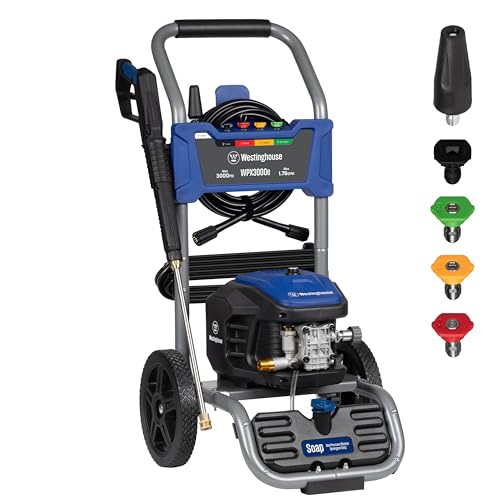
- ✓ Powerful 3000 PSI
- ✓ Easy maneuverability
- ✓ Quick-connect nozzles
- ✕ Heavy when fully loaded
- ✕ 25 ft might feel short for large jobs
| Max PSI | 3000 (max), 2600 (rated) |
| Water Flow | 1.76 GPM (max at lowest pressure), 1.1 GPM (rated) |
| Motor Type | Heavy duty AC 120V electric motor |
| Pump Type | Maintenance-free axial 3-piston auto-stop pump |
| Hose & Accessories | 25 ft abrasion-resistant hose; 5 quick-connect nozzles (0°, 15°, 25°, soap, turbo); M22 compatibility |
| Tank & Features | .45 gallon soap tank; GFCI cord (35 ft) |
You pull the Westinghouse WPX3000e out of the box and there’s an immediate sense of sturdiness. The steel frame feels solid, and the 10-inch never-flat wheels promise real-world portability on uneven driveways.
First impression hits when you lift the wand and spray gun: it’s a comfortable weight, with a textured grip that doesn’t slip when your hands are wet. The hose is long enough to reach the far corner of a deck without you dancing around the unit.
Under the hood, the induction motor purrs quietly for a pressure washer this powerful. It starts smoothly thanks to the efficient auto-stop pump, and the gauge of the spray tips feels premium.
You’ll notice the quick-connect nozzles snap in with a satisfying click, and the turbo tip really brings stubborn grime to its knees.
I used it on a typical suburban patio: wood decking, a brick walkway, and a vinyl fence. The 3000 max PSI gives you bite without feeling alarming; you’re in control, especially at the 2600 PSI rated setting for more delicate surfaces.
The soap tank is handy for quick soap-and-water blasts, which saved me from lugging a separate container.
The 25-foot hose reaches corners you’d normally skip, and the surface cleaner compatibility is a real bonus if you have wide slabs. The 3-year warranty gives you confidence that you’re not buying a disposable unit.
Assembly was minimal, and the quick-start guide got me cleaning in minutes.
Overall, it’s a solid mix of power, portability, and practical features for home projects. It handles cars, patios, and garage floors with ease, without feeling like a chore to use.
Giraffe Tools Electric Pressure Washer 1800W 2900 PSI
- ✓ Wall-mounted convenience
- ✓ Long, durable hose
- ✓ Strong, controllable spray
- ✕ Heavy to mount
- ✕ Hose reel can be fiddly
| Electrical Power | 1800 W induction motor |
| Maximum Water Pressure | 2900 PSI (max) |
| Water Flow Rate | 2.2 GPM (max) |
| Hose Length | 100 ft replaceable hose with retractable reel |
| Power Cord & Safety | 6 ft power cord with GFCI |
| Warranty | 2-year hassle-free warranty |
You discover something surprising the moment you pull this Giraffe Tools unit off the wall: it’s heavier than it looks, but the wall-mount makes pickup impossible to overlook. The blue body sits tidy on a bracket, and the 100 ft replaceable hose reels out with a smooth, almost cable-car glide.
I wasn’t expecting a machine this compact to feel like a full-blown cleaning setup.
Holding the wand, you’ll notice the quick-connects click into place with a solid snap. The 1800W motor thunders to life, yet it stays impressively quiet for a gas-free job.
With 2900 PSI on tap, stubborn grime on a driveway or tar on toffee-colored stone disappears faster than you’d expect.
The retractable hose system is a real winner in real-life chaos. You tug it and it locks into length, then smooths back with a gentle tug of the handle.
No more wrenched shoulders wrestling a loose hose after every pass. The 6 ft cord and GFCI plug feel reassuring when you’re working outside, with outlets that aren’t exactly gallery-perfect.
Four quick nozzles cover the basics, from a gentle rinse to a tight 0° punch. The foam cannon is surprisingly generous, letting you flood a car with thick suds before you scrub.
And the Total Stop System means you’re not wasting energy when you’re not squeezing the trigger.
It’s not all sunshine, though. The 100 ft hose is long, but you’ll want to map your route so you don’t sprint back and forth dragging a reel.
Still, for wall-mounted storage and big cleaning tasks, it’s a thoughtful setup that saves space and time.
Overall, the Giraffe Tools unit feels like a sturdy partner for weekly maintenance or big exterior cleanup days. It’s built for longevity, and the wall-mount plus long hose really changes how you approach a project.
What Is an Induction Motor Pressure Washer and How Does It Work?
An induction motor pressure washer is a cleaning device that utilizes an induction motor to power a high-pressure water pump, effectively removing dirt, grime, and other contaminants from various surfaces. Induction motors are known for their efficiency, durability, and low maintenance needs, making them an ideal choice for pressure washing applications.
According to the U.S. Department of Energy, induction motors account for approximately 60% of the total electrical energy used in the industrial sector, highlighting their significance in various applications, including pressure washing (U.S. Department of Energy, 2020). This type of motor operates on the principle of electromagnetic induction, where current flowing through coils generates a magnetic field, causing the rotor to turn and produce mechanical power.
Key aspects of induction motor pressure washers include their ability to deliver consistent power and pressure, which is essential for effective cleaning. These washers typically feature a robust electric motor that can generate higher RPMs compared to universal motors often found in less powerful pressure washers. This results in a more efficient operation with less noise and vibration. Additionally, induction motors have a longer lifespan due to fewer moving parts and less heat generation during operation, leading to reduced wear and tear.
The impact of using an induction motor pressure washer is significant in both residential and commercial settings. These devices not only improve cleaning efficiency but also conserve water due to their high-pressure capabilities. For instance, a pressure washer can use as little as 1.5 gallons of water per minute compared to a standard garden hose, which can consume 5 to 10 gallons per minute, thereby promoting water conservation (EPA WaterSense, 2021). Furthermore, the powerful cleaning action reduces the need for harsh chemicals, making it a more environmentally friendly option.
The benefits of induction motor pressure washers extend beyond efficiency and environmental considerations. They are ideal for tasks ranging from cleaning driveways, decks, and vehicles to industrial applications like machinery cleaning and surface preparation. Moreover, the availability of various pressure ratings and nozzle options allows users to customize their cleaning experience, making them versatile tools for different cleaning needs.
Best practices for using an induction motor pressure washer include regularly checking and maintaining the motor and pump, using the appropriate pressure settings for different surfaces, and employing proper safety gear. Additionally, users should ensure that the water supply is adequate and free from debris to prevent damage to the pump and motor. By following these guidelines, users can maximize the lifespan and effectiveness of their induction motor pressure washer.
What Are the Key Advantages of Induction Motor Pressure Washers?
The key advantages of induction motor pressure washers are numerous, making them a popular choice for various cleaning tasks.
- Durability: Induction motors are known for their robust construction, which allows them to withstand heavy use and adverse conditions. This durability translates into a longer lifespan for pressure washers, reducing the frequency and cost of replacements.
- Efficiency: These motors operate efficiently with less energy consumption compared to their universal motor counterparts. This efficiency results in lower electricity bills and makes them an environmentally friendly option for users.
- Quieter Operation: Induction motors generally produce less noise during operation, making them suitable for residential areas where loud machinery can be a nuisance. This quieter performance enhances user experience and allows for extended use without disturbing neighbors.
- Consistent Performance: Induction motors provide a steady and reliable output of power, ensuring that pressure washers can maintain optimal cleaning performance over time. This consistency is crucial for tackling tough cleaning jobs effectively.
- Low Maintenance: With fewer moving parts and a simpler design, induction motors require less maintenance than other types of motors. This translates to lower maintenance costs and hassle-free operation for users.
What Should You Consider When Choosing the Best Induction Motor Pressure Washer?
When choosing the best induction motor pressure washer, several key factors should be considered to ensure optimal performance and satisfaction.
- Motor Power: The power of the induction motor is crucial as it determines the pressure output and flow rate of the washer. A more powerful motor typically means better cleaning capabilities, making it suitable for tough jobs like removing grease or grime.
- Pressure Rating: Look for the pressure rating measured in PSI (pounds per square inch), which indicates the strength of the water spray. Higher PSI ratings are ideal for heavy-duty cleaning tasks, while lower ratings are sufficient for lighter jobs such as washing cars or patios.
- Flow Rate: The flow rate, measured in GPM (gallons per minute), affects how quickly you can clean surfaces. A higher flow rate allows for faster cleaning but may use more water, so finding a balance based on your needs is essential.
- Durability and Build Quality: A well-constructed pressure washer will last longer and perform better over time. Look for models with heavy-duty materials and components, as these are less likely to wear out or break during use.
- Portability: Consider the weight and design of the pressure washer, especially if you need to move it frequently. Features like wheels and a lightweight frame can enhance portability, making it easier to transport from one job site to another.
- Accessories and Attachments: Evaluate the included accessories, such as nozzles and extension wands, which can enhance the versatility of the pressure washer. A good selection of attachments allows you to tackle various cleaning tasks effectively.
- Noise Level: Induction motors are generally quieter than traditional motors, but some models can still be noisier than others. If noise is a concern, look for models specifically designed to operate with reduced sound levels.
- Warranty and Customer Support: A solid warranty and responsive customer support can provide peace of mind. Look for manufacturers that offer comprehensive coverage and are known for their customer service to ensure help is available if needed.
How Do Popular Models Like the Karcher K1700 Series Compare?
| Model | Power | Weight | Price | Power Source | Flow Rate | Warranty | Additional Features |
|---|---|---|---|---|---|---|---|
| Karcher K1700 | 1700 PSI – Suitable for light to medium tasks. | 32 lbs – Lightweight for easy maneuverability. | $250 – Mid-range price point. | Induction Motor | 1.2 GPM | 3 years | Onboard storage, 20 ft hose |
| Karcher K2000 | 2000 PSI – More power for tougher jobs. | 38 lbs – Slightly heavier than K1700. | $300 – Higher price reflects increased performance. | Induction Motor | 1.3 GPM | 3 years | Onboard storage, 25 ft hose |
| Karcher K3 | 1800 PSI – Good for basic cleaning tasks. | 30 lbs – Very portable and easy to store. | $150 – Budget-friendly option. | Induction Motor | 1.5 GPM | 2 years | Onboard storage, 20 ft hose |
What Essential Features Make a High-Quality Induction Motor Pressure Washer?
The essential features that define a high-quality induction motor pressure washer include:
- Powerful Induction Motor: A high-quality induction motor provides efficient operation and durability, ensuring consistent performance over prolonged use. Unlike universal motors, induction motors generate less noise and require less maintenance, making them ideal for heavy-duty cleaning tasks.
- High Pressure and Flow Rate: The best induction motor pressure washers offer high pressure (measured in PSI) and flow rate (measured in GPM) to tackle tough cleaning jobs effectively. Higher PSI allows for the removal of stubborn dirt and grime, while a good flow rate ensures that water covers a larger area quickly, enhancing overall cleaning efficiency.
- Durable Construction: Quality materials, such as metal frames and stainless steel components, contribute to a pressure washer’s longevity and resistance to wear and tear. A robust construction not only prolongs the life of the machine but also allows it to withstand harsh working conditions.
- Versatile Nozzle Options: A variety of nozzles enables users to adjust the spray pattern and pressure according to the cleaning task at hand. From a wide spray for rinsing surfaces to a narrow spray for tough spots, having multiple nozzle options increases the versatility of the pressure washer.
- Ease of Use: Features like an ergonomic handle, lightweight design, and easy-to-assemble components enhance user comfort and convenience. An intuitive control panel and an onboard storage for accessories also simplify operation and organization during use.
- Safety Features: High-quality pressure washers often come with built-in safety features such as thermal protection and automatic shut-off systems. These features help prevent overheating and promote safe usage, providing peace of mind while operating the machine.
- Warranty and Customer Support: A solid warranty and responsive customer support reflect the manufacturer’s confidence in their product. A lengthy warranty period indicates durability, while good customer support means users can easily obtain assistance or parts if needed.
What Maintenance Practices Ensure Longevity for Your Induction Motor Pressure Washer?
To ensure the longevity of your induction motor pressure washer, consider implementing the following maintenance practices:
- Regular Cleaning: Keeping your pressure washer clean is essential for its longevity. After each use, remove any dirt, debris, or soap residue, particularly from the nozzle and water inlet, to prevent clogs and corrosion.
- Check and Replace Filters: Induction motor pressure washers often have water filters that prevent dirt from entering the pump. Regularly inspecting and replacing these filters ensures optimal water flow and protects the internal components from damage.
- Inspect Hoses and Connections: Examine hoses and connections for any signs of wear or leaks. Replacing damaged hoses promptly not only prevents water loss but also avoids strain on the motor and pump, which can lead to failure.
- Lubrication of Moving Parts: Periodically lubricating the motor and pump components helps reduce friction and wear. Use the manufacturer-recommended lubricants, as this will ensure each part operates smoothly and extends the life of the pressure washer.
- Check Electrical Connections: Regularly inspect electrical components and connections for signs of wear or damage. Loose or corroded connections can lead to motor overheating or failure, so ensure all connections are tight and free from corrosion.
- Winterizing the Unit: If you live in an area with cold winters, it’s crucial to winterize your pressure washer to prevent freezing and damage. This involves draining water from the system and adding a non-toxic antifreeze solution to protect the internal components.
- Follow Manufacturer’s Maintenance Schedule: Always refer to the manufacturer’s manual for specific maintenance recommendations and schedules. Adhering to these guidelines ensures that you are performing the necessary checks and services at the right intervals for optimal performance.
What Are the Common Problems with Induction Motor Pressure Washers and Their Solutions?
Common problems with induction motor pressure washers include motor overheating, low pressure output, and electrical issues.
- Motor Overheating: Induction motors can overheat due to prolonged use or insufficient ventilation. This can lead to thermal damage or reduced lifespan. To solve this, ensure proper airflow around the motor and allow for regular breaks during continuous operation.
- Low Pressure Output: If the pressure washer is not delivering adequate pressure, it may be due to clogged nozzles, a malfunctioning pump, or inadequate water supply. Regularly check and clean the nozzles, inspect the pump for wear or damage, and ensure that the water source is sufficient and clean.
- Electrical Issues: Problems such as tripped circuit breakers or blown fuses can occur if the electrical system is overloaded or if there are faulty connections. To address this, check the electrical cords and connections for damage and ensure the pressure washer is plugged into a suitable outlet that meets its power requirements.
- Water Leaks: Leaks can manifest from worn seals, loose fittings, or damaged hoses, leading to reduced efficiency and potential damage. Regularly inspect all connections and hoses for wear, and replace any damaged parts to maintain optimal performance.
- Vibration and Noise: Excessive vibration or noise from the motor can indicate imbalanced components or loose screws. To mitigate this, ensure that all parts are securely fastened, and check for any obstructions or damage in the motor assembly that could be causing imbalance.